

Gross motor games for preschoolers: 20 a therapist plays in the gym

The best gross motor games for preschoolers are short, playful, and spread through the day. A few minutes of hopping, crawling, balancing, and catching at a time builds balance, strength, and coordination.
This guide lists 20 games our therapists use in the gym, with a line on why each one earns its spot. You will also get a simple home plan, quick notes for babies and 2-year-olds, the safety rules, and the signs that call for a physical therapist (PT) to take a look.
A licensed physical therapist (PT, DPT) on our team reviewed this guide before it went live. Our clinical team has served more than 10,000 kids over 22 years, and our PTs work on balance, strength, and coordination every day.
What games build gross motor skills in preschoolers?
Games that mix running, jumping, balance, and ball skills build gross motor skills in preschoolers. Think freeze dance, hopscotch, bear crawls, and beanbag toss. Variety matters most: federal guidelines say adults should encourage active play of many types, spread throughout the day, for children ages 3 to 5.
The U.S. Physical Activity Guidelines say preschoolers should be physically active throughout the day and that caregivers should encourage active play with a variety of activity types.
The World Health Organization puts a number on it. Children ages 3 to 4 need at least 180 minutes of physical activity a day, with at least 60 of those minutes at moderate to vigorous intensity. That sounds like a lot. Spread across a day of play, it adds up fast.
Why planned gross motor games beat free play alone
Free play matters, and planned games add something free play alone misses: practice on specific skills. The research shows the difference clearly.
A 2012 meta-analysis by Logan and colleagues found that motor skill programs improved fundamental movement skills, with an effect size of 0.39. Children in control groups who had free play only showed no significant change (effect size 0.06).
A larger 2017 review by Wick and colleagues pooled 30 trials with 6,126 preschoolers ages 3 to 5. Programs improved overall movement skills, and the gains were largest for ball skills and locomotor skills like running, hopping, and jumping.
What makes a game planned? It has a target skill, a clear goal, and a way to make it a little harder next time. Freeze dance becomes a balance game when the freeze is on one foot. Beanbag toss becomes an aiming game when the basket moves back one step. The best gross motor skills games for preschoolers grow with the child.
So keep the free play. Add a few planned gross motor games for preschoolers each day, with a clear skill in mind, and give your child a reason to practice it.
Gross motor games for preschoolers: the 20-game list
Here are 20 gross motor games for preschoolers, grouped by skill. Each one has a short note on why a PT likes it. Most need nothing more than tape, pillows, and a ball.
Balance (1-5)
- Stepping stones: step across pillows or paper plates on the floor. Why a PT likes it: each step is a small balance challenge.
- Floor is lava: move from couch cushion to cushion without touching the floor. Why a PT likes it: it mixes balance with planning.
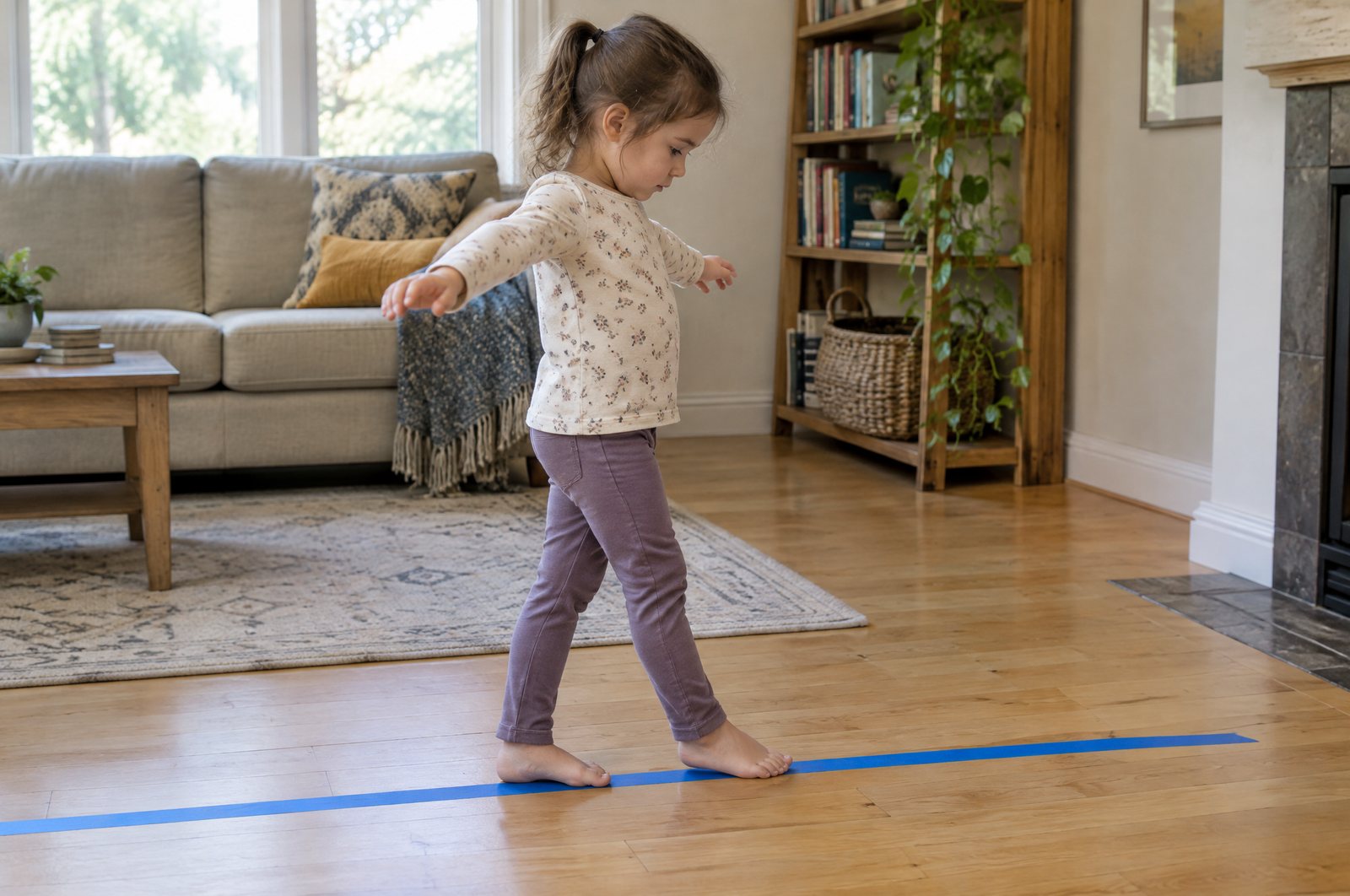
- Beam walk on tape: walk heel to toe along a line of painter's tape. Why a PT likes it: a narrow path trains steady, controlled steps.
- Freeze dance: dance, then freeze when the music stops. Why a PT likes it: stopping fast builds body control.
- Egg-and-spoon race: carry a hard-boiled egg on a spoon. The AAP says egg races promote balance and dexterity. Why a PT likes it: the eyes and body work together.
Strength and core (6-10)
- Bear crawl: walk on hands and feet across the room. Why a PT likes it: it loads the arms, shoulders, and core.
- Crab walk race: belly up, hands and feet down, race to a line. Why a PT likes it: it builds strength in the back of the body.
- Scooter board on the ramp: ride a scooter board down a ramp on the belly. Why a PT likes it: holding the head and chest up works the back and neck.
- Tug of war: pull a soft rope with a partner. Why a PT likes it: it uses the whole body, from grip to legs.
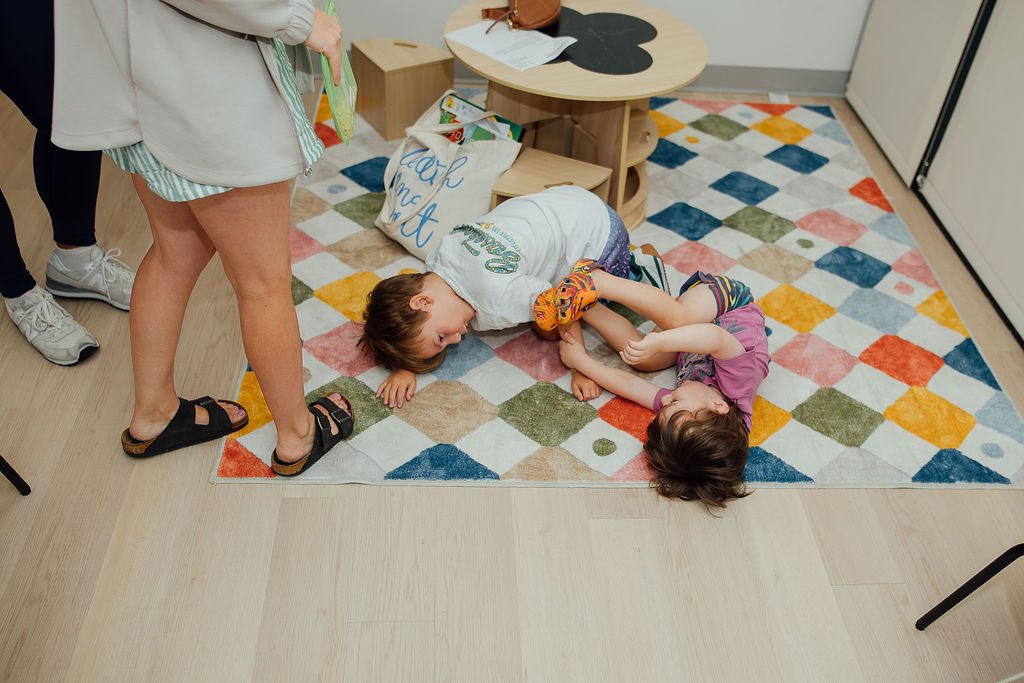
- Climbing the fort: climb up, crawl through, and slide down. Why a PT likes it: climbing builds strength and coordination at once.
Jumping and hopping (11-14)
Jumping games do double duty. The Physical Activity Guidelines list hopping, skipping, jumping, and tumbling as bone-strengthening activities for young children.
- Jumps into crash pads: jump from a low step onto a soft landing. Why a PT likes it: landing safely teaches control.
- Hopscotch: hop and jump through chalk squares. Why a PT likes it: it switches between one foot and two.
- Frog jumps: squat low, then jump forward. Why a PT likes it: deep squats and jumps build leg power.
- Hops along a line: hop on one foot along a tape line. Why a PT likes it: single-leg hops build balance and strength together.
Ball and coordination (15-20)
- Kick to target: kick a ball at a box or between two cones. Why a PT likes it: aiming adds control to power.
- Big-ball catch: toss and catch a large, soft ball. Why a PT likes it: catching builds eye-hand timing.
- Beanbag toss: throw beanbags into a laundry basket. Why a PT likes it: it trains aim without the bounce of a ball.
- Balloon volley: keep a balloon in the air. Why a PT likes it: a slow balloon gives time to react.
- Bubble chase: chase and pop bubbles. Why a PT likes it: it mixes running, reaching, and jumping.
- Red light, green light: run on green, stop on red. Why a PT likes it: starting and stopping on cue builds control.
Bear crawls, crab walks, and frog jumps also star in our free Animal Walk Adventure game, which walks your child through each move with a spinner and timer.
How to run a gross motor activity at home
A gross motor activity at home works best when it is short and simple. Five steps cover it.
- Pick 3 games. Choose one from two or three different groups, like balance, jumping, and ball.
- Clear a safe space. Move furniture with sharp corners, use a rug or soft surface, and take off shoes.
- Demonstrate first. Show the move once, slowly, and let your child copy you.
- Take turns. Your turn, then theirs. Turn-taking adds rest breaks and makes it a game.
- End on a win. Finish with a game your child does well so they want to play again.
Build a couch-cushion obstacle course
Our gyms use obstacle courses because one course hits many skills at once. At home, couch cushions do the job. Lay cushions as stepping stones, add a pillow to crawl over, a tape line to walk, and a laundry basket at the end for a beanbag toss.
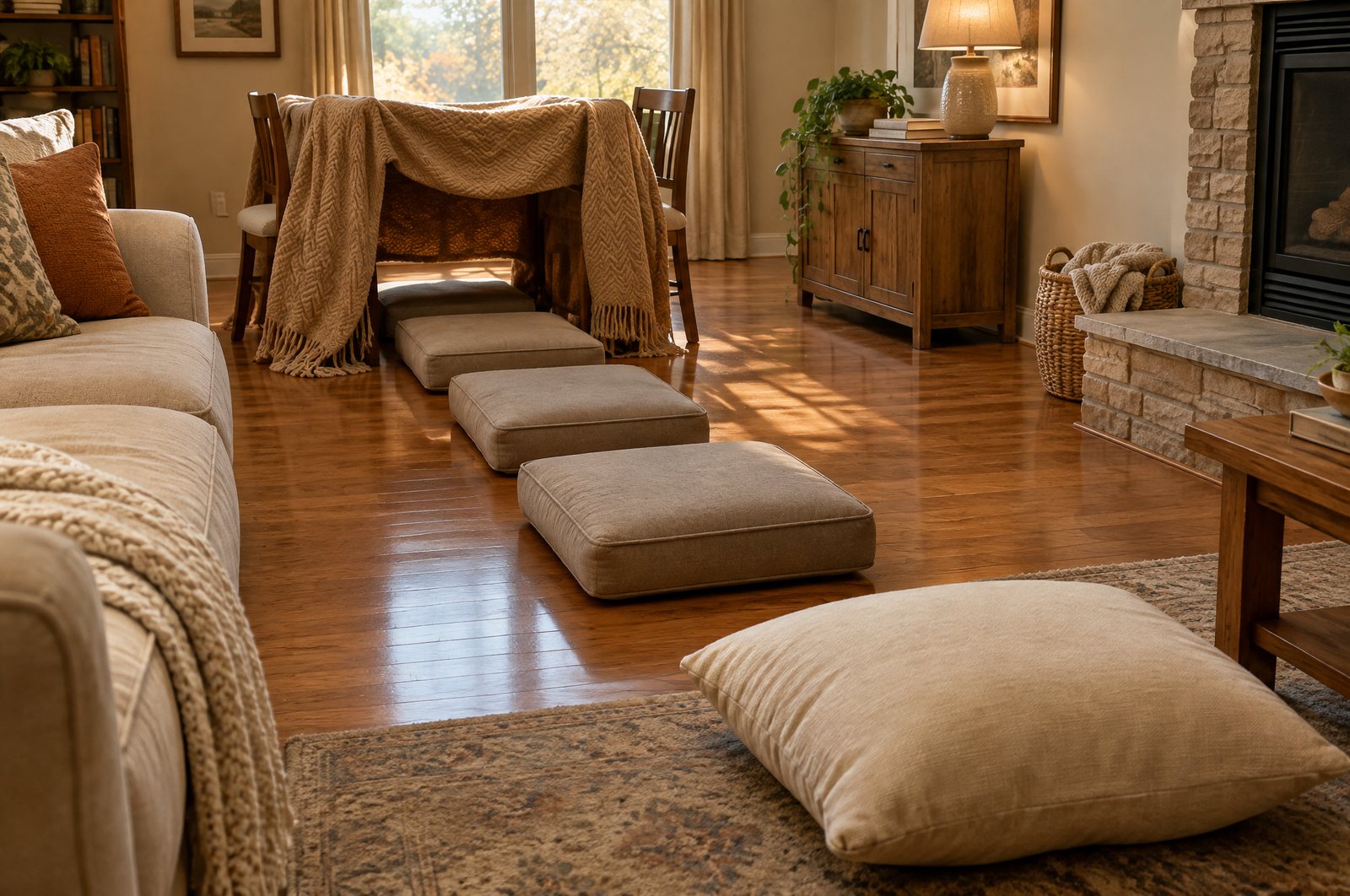
Two setup moves make a home course safer and more useful. First, build it on a rug or carpet, since couch cushions slide on wood and tile floors. Second, make it a loop, so the last station leads back to the first. Your child can run it three or four times in a row, and each lap is another round of practice.
Let your child help plan the order. Choosing where each cushion goes and what comes next is part of the challenge, and kids try harder on a course they built themselves.
Keep each round short and cheer the effort as much as the result. Change one thing each time you play: a longer tape line, a bigger jump, or a smaller target. Small changes keep the game fresh and the challenge right.
For animal moves, skip the setup and open our Animal Walk Adventure game. It runs about 5 minutes for 5 animals.
Infant gross motor activities and two-year-olds
Babies and toddlers need movement too, in smaller doses. These infant gross motor activities and toddler ideas keep it simple.
Babies
For babies who are still learning to move around, the WHO recommends at least 30 minutes of tummy time a day, spread throughout the day while awake. Tummy time is one of the best gross motor skills activities for infants, because it builds the neck, shoulder, and back strength used later for crawling.
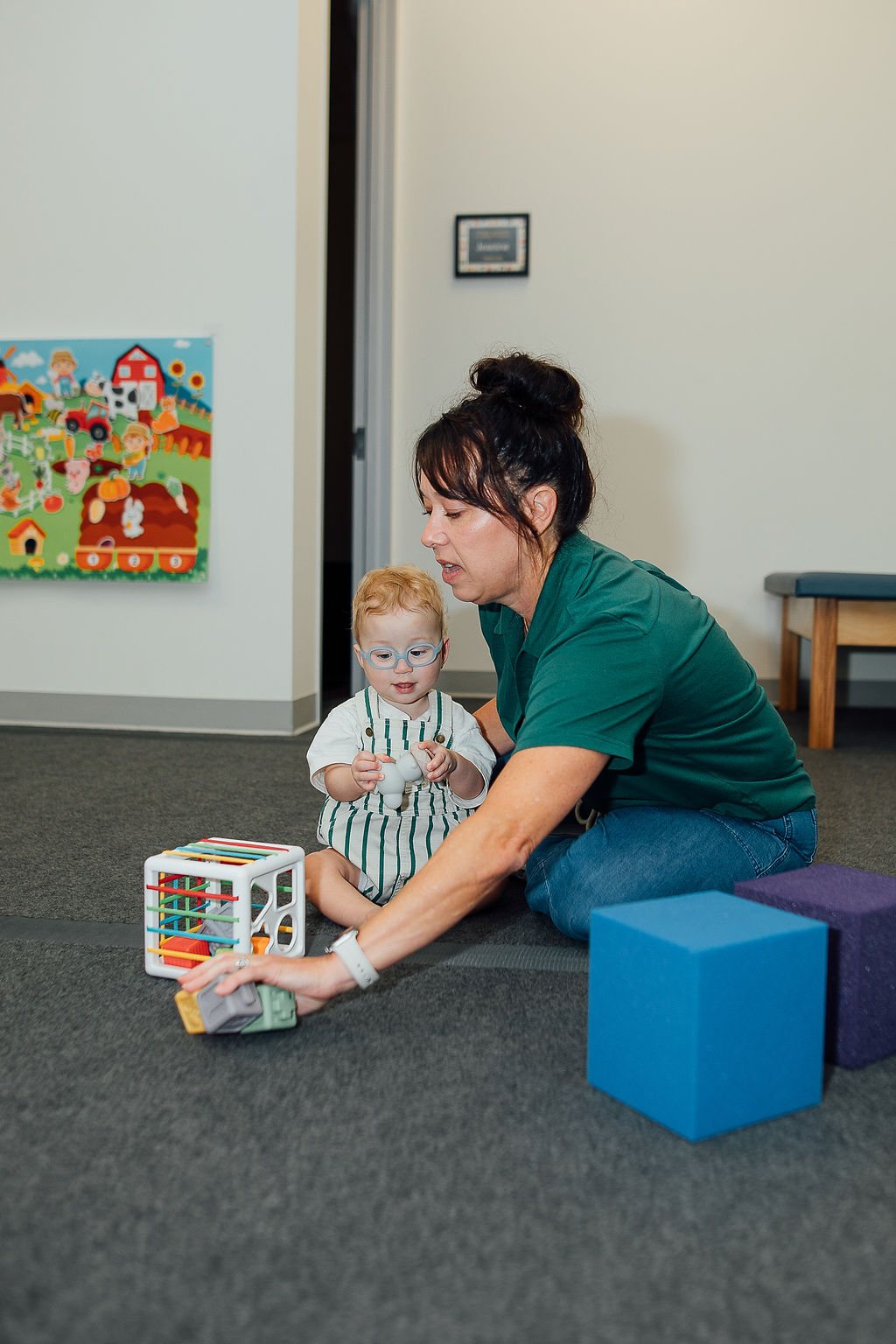
Simple infant gross motor skills activities start on the floor. Tummy time on a blanket, on your chest, or with a toy a little out of reach all count toward the daily total. Floor time gives babies room to push, roll, and reach.
Two-year-olds
By age 2, the CDC says most children kick a ball, run, and walk up a few stairs with or without help. Good gross motor activities for two-year-olds build on those: kicking a big ball, chasing bubbles, and walking up and down a few stairs while holding your hand.
For the full list of milestones by age, read our guide to fine motor skills vs gross motor skills.
Safety rules for gross motor games
Most gross motor games are low risk with a grown-up nearby. Two rules matter most.
- No trampoline games at home. The AAP says children under 6 should never jump on trampolines. Toddlers and preschoolers face the highest injury risk.
- Supervise climbing and use soft landings. Put pillows or a soft mat under anything your child climbs or jumps from, and stay within arm's reach.
Also keep the play space clear, use bare feet or grippy socks on smooth floors, and stop any game that hurts.
Signs a child may need a PT look
Play builds skills, and some children need more support. The CDC milestones give a few useful checkpoints.
- By age 4: most children catch a large ball most of the time.
- By age 5: most children hop on one foot.
- Any age: a lost skill, or a child who avoids moving again and again.
If you see these signs, talk with your child's doctor and ask about developmental screening, as the CDC advises. A PT evaluation can show where your child stands and which skills to build. If you notice your child often sits in a W shape, our guide to W-sitting explains when it matters.
Gross motor games for preschoolers are a great start at home. When a skill stalls or slips, a PT can add a clear plan.
Frequently Asked Questions
How long should gross motor games for preschoolers last?
A few minutes per game is plenty. The WHO recommends at least 180 minutes of activity a day for ages 3 to 4, so short games spread through the day add up.
Are trampolines good for toddlers?
No. The AAP says children under 6 should never jump on trampolines, and toddlers and preschoolers face the highest injury risk.
Can gross motor games be played indoors?
Yes. Freeze dance, bear crawls, a tape-line balance beam, balloon volley, and a couch-cushion obstacle course all work indoors.
What gross motor activities work for two-year-olds?
Kicking a big ball, running, chasing bubbles, and walking up a few stairs with help. These match the CDC milestones for age 2.
Next step
Three things to remember. Short, playful games through the day build balance, strength, and coordination. Planned games add skill practice that free play alone misses. And watch for a lost skill or a child who avoids moving.
Want to go deeper? Read our guides to fine motor skills vs gross motor skills and W-sitting. Our guide to fine motor activities for preschoolers pairs well with this list. Our pediatric physical therapy page explains how PT works at our clinics.
If you have questions about how your child moves, our 10-minute Get Started form is a low-pressure first step. Oaklin Lane's team will talk with you about what you are seeing and check your benefits.
Every child is different. Play and therapy can help, and results vary from child to child. This guide is general information and carries no guarantee of a specific outcome. Talk with your child's doctor about your child's needs.
Sources
- U.S. HHS, Physical Activity Guidelines for Americans, 2nd edition (2018)
- WHO, To grow up healthy, children need to sit less and play more (April 24, 2019)
- Logan et al. (2012), Getting the fundamentals of movement: a meta-analysis, Child Care Health Dev 38(3)
- Logan et al. (2012) conference abstract with effect sizes, AAHPERD
- Wick et al. (2017), Interventions to promote fundamental movement skills in childcare and kindergarten, Sports Med 47(10)
- AAP HealthyChildren, 10 no-cost, screen-free activities to play with your preschooler
- AAP HealthyChildren, Trampolines: what you need to know (updated September 3, 2024)
- CDC, Milestones by 2 years
- CDC, Milestones by 4 years
- CDC, Milestones by 5 years