

Occupational therapy for infants: what OT looks like before age one

Infant OT is mostly play, positioning, feeding support, and coaching for parents. For a baby, occupational therapy looks like floor time with a therapist who knows exactly which reach, roll, or grasp to invite next.
This guide explains what OT does for babies, where it starts for newborns in the hospital, why babies get referred, which hand milestones OTs watch before age one, what a session looks like, and where Texas Early Childhood Intervention (ECI) comes in.
A licensed occupational therapist (OTR/L) on our team reviewed this guide before it went live. Our clinical team has served more than 10,000 kids over 22 years, and we see children from birth to age 21.
What does occupational therapy do for a baby?
Occupational therapy helps a baby with the daily jobs of infancy. An OT supports play and exploration, nap and bedtime routines, feeding, and early movement and thinking skills. Parents are part of every step, so the work continues at home between visits. The goal is a baby who can explore, eat, and rest well.
The American Occupational Therapy Association (AOTA) lists these areas in its parent guide to OT for babies and toddlers: helping children play and explore, build nap and bedtime routines, eat new foods, and develop thinking and movement skills.
AOTA's early childhood practice guideline covers OT from birth to age 5. It includes prematurity, feeding disorders, NICU care, and cerebral palsy, along with motor, sensory, emotional regulation, and thinking skills. In short, OT for infants covers far more than hands.
A picture of infant OT
Picture a 7-month-old who cries every time she lands on her tummy and keeps one hand fisted while the other reaches. An OT might start with short tummy time on a parent's chest, then add a favorite toy to invite a reach with the quieter hand. Week by week, the goals grow as her skills do.
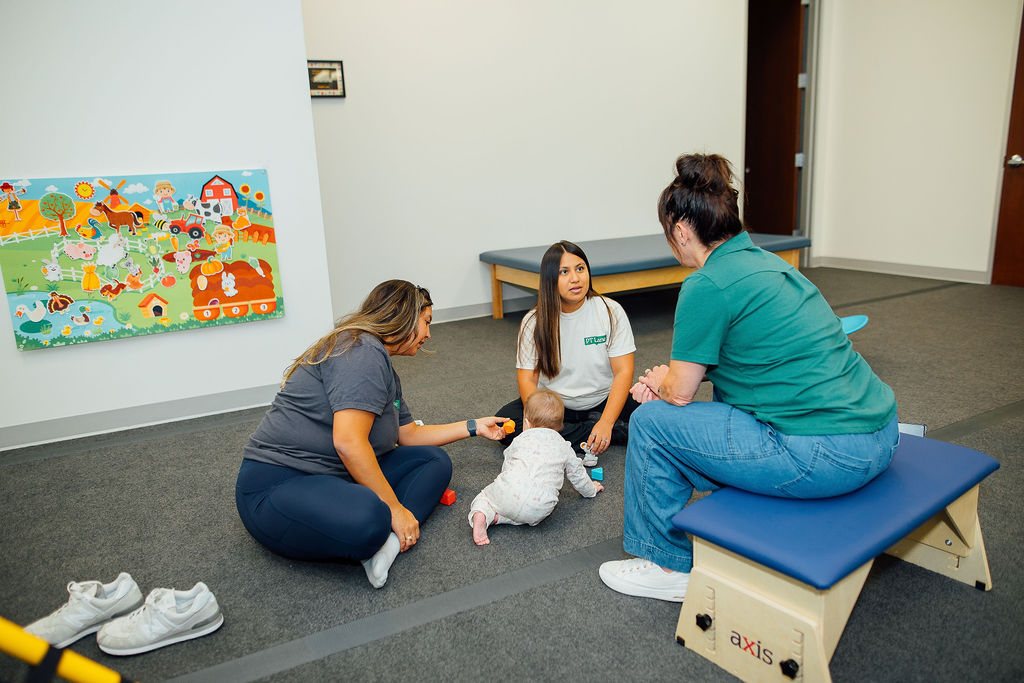
Sleep, feeding, and play are all OT territory
Parents are often surprised that OT covers sleep and feeding. AOTA lists nap and bedtime routines and eating new foods right next to play and movement. That is because each one depends on how a baby takes in touch, sound, and movement, and how the body settles afterward.
For a baby, the "occupations" are simple: eating, sleeping, playing, and being held. When any of those gets hard, an OT looks at why, then builds a plan around everyday routines.
Occupational therapy for newborns starts in the NICU
For many babies, occupational therapy for newborns starts before they ever come home. OTs work in the neonatal intensive care unit (NICU), where AOTA treats practice as a specialized area.

AOTA published a 2018 paper on occupational therapy's role in the NICU. NICU OTs help with how a baby is positioned and handled, with feeding, and with teaching parents. A 2022 AOTA article notes that NICU OTs teach parents how to meet their baby's needs at home, including bathing and feeding, and that discharge is one of the most stressful times for parents.
After the hospital
Outpatient infant occupational therapy picks up after the baby goes home. The setting changes from an isolette to a play mat, and the goals shift toward the next skills: reaching, holding, rolling, eating, and settling.
Questions worth asking the NICU team before you go home:
- Did an OT see my baby, and what did they work on?
- Which positions and holds should we keep using at home?
- Are there feeding goals we should keep practicing?
- Do you recommend follow-up OT or early intervention after discharge?
If your baby spent time in the NICU, ask the team before discharge whether they recommend follow-up OT. Bring that note to your pediatrician, who can send a referral.
Reasons babies are referred for OT
Babies are referred for OT for conditions present at birth, for feeding struggles, and for unusual reactions to movement or touch.
Conditions present at birth
Our pediatric OT guide lists conditions our OTs commonly support, including brachial plexus injury, arthrogryposis, polydactyly, and syndactyly. Each can affect how a baby uses the arms and hands from the first weeks of life.
- Brachial plexus injury: an injury to the nerves that run from the neck to the arm, which can weaken the arm.
- Arthrogryposis: joints that are stiff or fixed at birth.
- Polydactyly: extra fingers or toes.
- Syndactyly: fingers or toes joined together.
For these babies, an OT can help with range of motion, positioning, and hand use, often alongside the baby's medical team.
Everyday signs
The same guide lists infant red flags that often lead to an OT referral:
- Trouble coordinating sucking and swallowing during feeds
- Strong resistance to tummy time
- Extreme reactions to textures or being touched
- Delayed grasp and release
- Missed motor milestones on the CDC checklists
Early signs of cerebral palsy
Cerebral palsy (CP) can now be spotted early. A 2017 review in JAMA Pediatrics by Novak and colleagues found that CP can be accurately diagnosed before 6 months corrected age. The General Movements Assessment, which watches a baby's natural movements, showed 98% sensitivity before 5 months corrected age. The review says an early diagnosis should always be followed by a referral to early intervention.
If your baby was born early or had a hard start in the NICU, ask your pediatrician whether early screening makes sense. Early answers mean earlier support, during the months when a baby's brain is changing fastest.
Low muscle tone and torticollis are also common reasons babies start therapy. Our upcoming guides to hypotonia in infants and infant torticollis cover both in depth.
Hand milestones OTs track before age one
OTs track how a baby's hands grow from swiping to precise pinching across the first year. Two CDC checkpoints give a useful snapshot.

- By 9 months: most babies move things from one hand to the other and use their fingers to rake food toward themselves.
- By 12 months: most babies pick things up between thumb and pointer finger, like small bits of food.
Use corrected age for preemies
If your baby was born more than 3 weeks early, the CDC says to use corrected age when checking milestones. Corrected age is your baby's age from the due date, which gives a fairer comparison.
Between checkpoints, watch how your baby uses both hands. Note whether they reach for toys, bring hands together, and explore objects by touching and mouthing them. Short phone videos of play help your pediatrician see what you see.
Checklists help, and evaluations decide
AOTA says the CDC checklists are a great tool for parents, and they are no substitute for formal developmental screening and evaluation by trained providers. Use the checklist to start a conversation with your pediatrician. Use an evaluation for answers.
Infant OT: what a session looks like
An infant OT session looks like play on a mat, with a parent right there. The therapist sets up each moment on purpose, and parents learn the moves to repeat at home.
The evaluation
The first visit is an evaluation. Our guide to developmental assessments explains the process: a parent interview about your concerns and history, then play-based testing. For babies, common tools include the Alberta Infant Motor Scale, the Test of Infant Motor Performance for the youngest infants, and the PDMS-3, which covers motor skills from birth through 5 years 11 months.
At our clinics, an initial evaluation usually takes about an hour and is often scheduled within 2 weeks. It ends with a caregiver conference, where the therapist explains the results and the plan of care.
What to bring to the first visit:
- Your insurance information and your doctor's contact details
- A short list of what you notice, with ages and dates when you can
- Phone videos of feeding, play, or tummy time
- Hospital or NICU discharge notes, if your baby has them
Treatment and home carryover
Infant OT treatment happens mostly on the floor. A session might include:
- Floor play: time on the tummy, back, and side, with toys placed to invite new movement.
- Reaching: toys placed in the right spot so the baby reaches, grasps, and lets go.
- Positioning: ways to hold, carry, and seat the baby to support good movement.
- Feeding practice: support for bottle, breast, or early spoon feeding, when feeding is a goal.
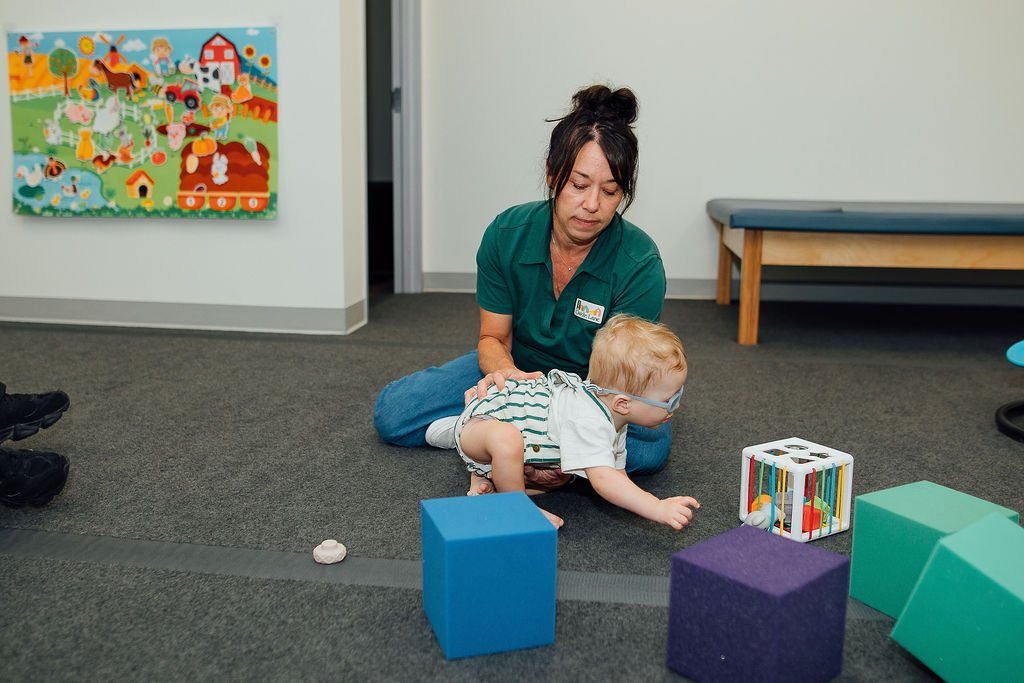
Parents learn each move during the session. Every family leaves with a home program, so practice slides into diaper changes, bath time, and play. Infant OT works best when most of the practice happens at home.
OT and PT sessions are most often 45 minutes, usually twice a week, and plans are individualized to each baby.
How progress is tracked
After the evaluation, the therapist writes a plan of care with short-term and long-term goals. A short-term goal might be a steadier reach during tummy time. A long-term goal might be picking up small bits of food at mealtime. Progress is checked against those goals, so you can see change over time.
- Starting point: At 6 months, a baby reaches for a toy during tummy time but drops to the floor after a few seconds.
- Short-term goal (about 6 weeks): The baby holds weight on one forearm and reaches for a toy with the other hand, 3 out of 4 tries.
- Long-term goal (about 6 months): The baby picks up small bits of food with thumb and pointer finger at mealtime.
Early intervention OT in Texas
Early intervention OT in Texas comes through ECI, a state program for children from birth to 36 months. It is a separate path from clinic-based therapy.
Who qualifies
Texas Health and Human Services says a child under 36 months who lives in Texas qualifies for ECI with one of the following:
- A medically diagnosed condition likely to cause a developmental delay
- A 25% delay in one or more areas of development
- A 33% delay if the delay is in communication only
- A vision or hearing impairment, as defined by the Texas Education Agency
How ECI works
Anyone can refer a child to ECI, including parents, grandparents, child care staff, and doctors. No diagnosis is needed. Most services happen at home or in another place the child spends time, and ECI coaches parents to build skills into daily routines.
Getting started with ECI
You can contact your local ECI program directly. ECI completes an evaluation and assessment, and if your child qualifies, the team and family write an Individualized Family Service Plan (IFSP). The IFSP sets the goals and the services.
Some ECI services are free, including the evaluation, service coordination, and the family's service plan. ECI may ask to bill your insurance for other services. If you are also considering clinic-based OT, ask your ECI service coordinator how the two can work together.
Occupational therapist early intervention vs PT
An occupational therapist in early intervention focuses on hands, feeding, sensory processing, and daily routines. A physical therapist focuses on big movements like rolling, sitting, crawling, and walking.
| Occupational therapy (OT) | Physical therapy (PT) | |
|---|---|---|
| Main focus | Hands, feeding, sensory processing, daily routines | Rolling, sitting, crawling, walking |
| Common infant goals | Reach, grasp, and release; feeding; settling | Head control, sitting balance, moving across the floor |
| Example referral | Trouble coordinating sucking and swallowing | Head tilt from torticollis |
Many babies see both. A baby with torticollis might see PT for neck range of motion, while an OT helps with feeding position or reaching to both sides. The two plans support each other.
For a full look at PT from birth through the teen years, read our guide to children's PT. It covers torticollis, tummy time coaching, and early gross motor milestones.
The simple test: if the question is about hands, eating, or how your baby handles touch and sound, start with infant OT. If it is about rolling, sitting, or walking, start with PT. Your pediatrician can refer for one or both.
Frequently Asked Questions
Does my baby need a referral for infant OT?
At our clinics, yes. Therapy requires a referral from your child's doctor, and doctors can fax it straight to us. Texas ECI is different: anyone can refer, and no diagnosis is needed.
How young can a baby start OT?
From birth. OTs work in the NICU with newborns, and our clinics see children from birth to age 21.
Is tummy time part of OT?
Often, yes. Strong resistance to tummy time is one of the infant signs that leads to an OT referral, and OTs coach parents on positioning. The WHO recommends at least 30 minutes of tummy time a day for babies who are still learning to move around. Our upcoming tummy time guide covers it in depth.
Will insurance cover OT for infants?
Coverage depends on your plan. Our clinics are in-network with several Texas Medicaid plans and many commercial plans, and our office staff checks your benefits before treatment begins.
Next step
Three things to remember. Infant OT is play, positioning, feeding support, and parent coaching. A checklist can start the conversation, and an evaluation gives answers. And in Texas, ECI is open to any child under 36 months who qualifies.
Want to go deeper? Our pediatric occupational therapist page explains OT at our clinics. Our upcoming guides to hypotonia in infants, infant torticollis, and tummy time will cover the most common infant concerns.
When you are ready, fill out our 10-minute Get Started form. Oaklin Lane's team will talk with you about what you are seeing, check your benefits, and schedule an evaluation, usually within 2 weeks.
Every child is different. Therapy can help, and results vary from child to child. This guide is general information and carries no guarantee of a specific outcome. Talk with your child's doctor about your child's needs.
Sources
- AOTA, Occupational therapy services for babies and toddlers
- Frolek Clark and Kingsley (2013), Occupational Therapy Practice Guidelines for Early Childhood: Birth to 5 Years, AOTA Press
- AOTA (2018), Occupational therapy’s role in the neonatal intensive care unit, AJOT 72(Suppl. 2)
- Adams, Lau, and Coon (2022), NICU Parent Educational Empowerment Program, OT Practice
- Novak et al. (2017), Early, accurate diagnosis and early intervention in cerebral palsy, JAMA Pediatrics 171(9)
- CDC, Milestones by 9 months
- CDC, Milestones by 1 year
- CDC, 1-year milestone checklist (corrected age note)
- AOTA, CDC milestone guidelines FAQ (March 1, 2022)
- Texas HHS, Early Childhood Intervention: information for families
- WHO, To grow up healthy, children need to sit less and play more (April 24, 2019)