
Occupational therapy for dysgraphia: fixing handwriting at the root

Occupational therapy treatment for dysgraphia starts with one question: why is the writing breaking down? The "root" is found in the evaluation, where an occupational therapist (OT) looks at grip, posture, visual-motor skills, and letter memory. The handwriting itself gets better through practice on real writing, with the root causes worked on inside that practice.
This guide is for parents whose child works hard on homework and still turns in pages nobody can read. You will learn what dysgraphia is, who diagnoses it, which signs matter most, what OT sessions include, how long therapy takes, and which school supports help along the way.
A licensed occupational therapist (OTR/L) on our team reviewed this guide before it went live. Our clinical team has served more than 10,000 kids over 22 years, and our OTs treat handwriting difficulty and dysgraphia at both of our clinics.
How does occupational therapy help a child with dysgraphia?
Occupational therapy helps a child with dysgraphia in four steps. The OT evaluates the causes behind the messy writing. The child practices real writing in every session. The OT teaches the child to check and fix their own letters. Then the OT suggests classroom tools so school work keeps moving while skills grow.
The research behind that order is clear. The American Occupational Therapy Association (AOTA) rates the evidence for therapeutic handwriting practice as strong. On the same page, AOTA finds no evidence for isolated activities that train the parts of handwriting on their own, like in-hand manipulation, visual perception, or visual-motor drills done away from the page.
So a good plan keeps the pencil in your child's hand. Putty, beads, and mazes can warm up the hands, and the core of every session is writing letters, words, and sentences.
What dysgraphia is, and who diagnoses it
Dysgraphia is a writing disability. The Texas Education Agency (TEA) describes it as illegible and/or inefficient handwriting due to trouble with letter formation, and lists it as a related disorder of dyslexia.
The medical name
The DSM-5-TR, the manual used for diagnosis, has no entry called "dysgraphia." The American Psychiatric Association links dysgraphia to specific learning disorder with impairment in written expression. That label covers spelling, grammar, punctuation, and organizing ideas on paper.
Who makes the call
A school team or a psychologist identifies dysgraphia. In Texas public schools, a multidisciplinary team runs the evaluation, and TEA says there is no single instrument, score, or formula that rules dysgraphia in or out. TEA adds that it would likely be appropriate for an OT to be part of that evaluation team.
OTs play a different role outside that team. We measure the motor and visual skills behind writing and treat them. The diagnosis itself comes from the school team or a psychologist.
Signs of poor fine motor control in writing
The clearest sign of dysgraphia is a gap: your child's written work falls far below what they can say out loud. Most other signs show up on the page itself.

TEA's guide for parents lists these signs of dysgraphia:
- Letters formed poorly or in odd ways
- Lots of erasing and crossing out
- Poor spacing between letters and words
- Letter and number reversals beyond second grade
- An awkward, inconsistent pencil grip
- Heavy pressure and tired hands
- Trouble copying words and finishing writing assignments
Watch for the gap most. Ask your child to tell you a story, then write the same story. A child who tells a rich, detailed story and writes three short, hard-to-read lines is showing a pattern worth checking. As our guide to pediatrics and occupational therapy puts it, that gap separates a skills problem from a knowledge problem.
Poor fine motor control is one possible cause. Visual-motor weakness, weak letter memory, and low hand strength can each play a part. For age-by-age milestones, see our guide to fine motor skills vs gross motor skills and our upcoming fine motor skills by age reference.
Occupational therapy treatment for dysgraphia: what sessions include
Occupational therapy treatment for dysgraphia has two parts: an evaluation that finds the root causes, and sessions built around real writing tasks that work on those causes.
The handwriting OT evaluation
A handwriting OT evaluation looks at the whole writer, from the chair up. A handwriting primer for OTs from New York University names posture, pencil grasp, visual-motor integration, legibility, and speed. OTs also watch stamina, since tired hands are on TEA's list of signs. Here is what each one means:
- Grasp and posture: how your child holds the pencil and sits at the desk
- Visual-motor skills: how well the eyes guide the hand
- Legibility: whether letters, spacing, and sizing can be read
- Speed: how fast your child writes and copies
- Stamina: how long your child can write before the hand tires
At our clinics, an initial evaluation usually takes about an hour. It ends with a caregiver conference, where the OT walks you through the results and the plan.
Interventions for dysgraphia that work
Three research reviews point the same way: practice the real task.
- Teach handwriting directly. A 2016 meta-analysis by Santangelo and Graham found that teaching handwriting improved legibility (effect size 0.59) and fluency (0.63). Motor instruction on its own made almost no difference (0.10 for legibility).
- Build self-management. A 2021 review of children with specific learning disabilities by Bray and colleagues found that interventions that promoted self-management and used writing itself as the therapy worked best. In a session, that looks like a child setting a goal, checking their own letters, and fixing them.
- Train the task, then the parts. A 2013 meta-analysis of children with developmental coordination disorder found task-oriented approaches far stronger (effect size 0.89) than process-oriented ones (0.12). That review measured overall motor skills, and the lesson carries over: practice the skill you want to improve.
In a session, this means short, focused writing tasks. Your child might trace, copy, and then write a letter from memory, say the steps out loud, circle their best letter, and fix the one that drifted off the line.
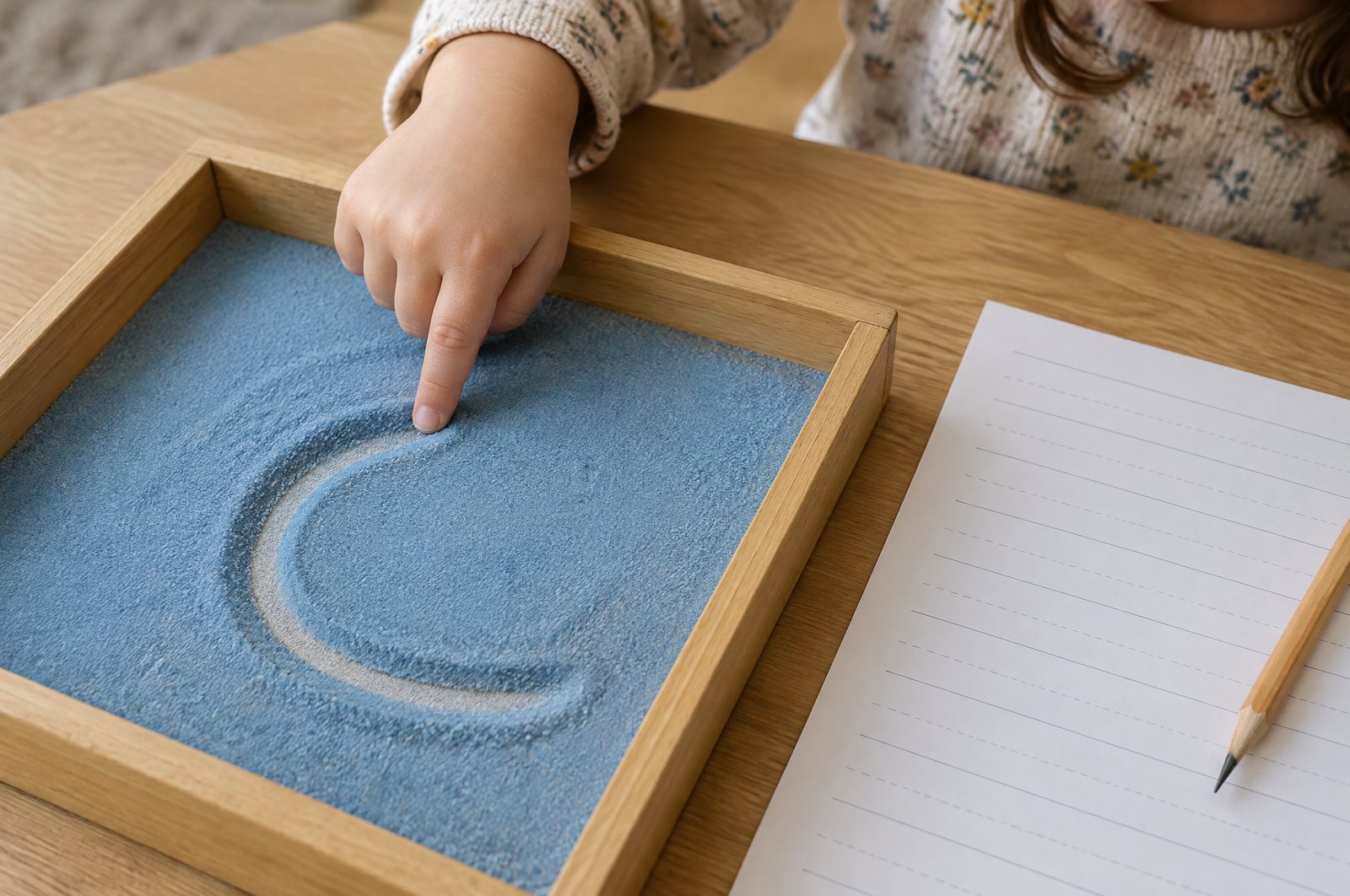
Handwriting OT also uses play. A child might form letters in a sand tray, then write them on paper, then use them in a sentence about their favorite game. In our gyms, a child might crawl through the obstacle course to collect letter cards, then sit down and write the word they spell. The play keeps a hard skill fun, and every activity ends back on the page.
Fine motor difficulties: what the root means
The "root" is the cause behind the writing problem. For one child it is grip. For another it is posture, visual-motor skill, or remembering how letters are formed.
Fine motor difficulties tell you where to look, and the treatment still happens in writing. If grip is the root, the OT works on grip while your child writes words. If letter memory is the root, the OT works on letter formation in real sentences. Separate drills away from the page have no evidence behind them, according to AOTA.
What the research says about tools
Weighted pencils and iPads alone lack support in the research. A 2022 scoping review of eight studies by Cole found that the iPad and weighted pencil studies showed no significant handwriting gains, and the program that skipped handwriting practice also showed no benefit. The programs that worked used task-specific practice.
Tools still have a place. A pencil grip or a different pen can make writing more comfortable. They work best as support for practice, in place of a stand-alone fix.
How long dysgraphia occupational therapy treatment takes
Dysgraphia occupational therapy treatment usually takes months of steady practice. The research gives a useful floor of about 20 sessions.
That floor matters when you compare options. If a plan for occupational therapy treatment for dysgraphia offers a handful of visits and a worksheet packet, ask how it will reach 20 sessions of real writing practice.
A 2011 systematic review by Hoy, Egan, and Feder looked at 11 handwriting studies. Programs with fewer than 20 sessions, and programs with no writing practice, were ineffective. Programs that included real handwriting practice did better.
At Oaklin Lane, OT is usually delivered in 45-minute sessions, often twice a week, per our pediatric occupational therapist page. At that pace, 20 sessions takes about 10 weeks. Plans are individual, and progress is reviewed at set points against the goals set at the evaluation.
Expect progress in steps. Many children first get more comfortable at the desk and with the pencil, then their letters get more consistent, then their speed and stamina grow. Your OT tracks legibility and speed against the goals from the evaluation, so you can see the change in numbers as well as on the page.
Home practice speeds things up. Every family leaves with a home program, so the work continues between visits. A few minutes of focused writing most days keeps skills moving.
School accommodations alongside therapy
Therapy builds the skill over time. School accommodations keep your child learning while that skill grows. The two work best together: occupational therapy treatment for dysgraphia improves the handwriting, and accommodations keep grades from riding on it in the meantime.

Understood lists classroom accommodations for dysgraphia, including:
- Extra time to take notes and copy material
- Typed copies of class notes or lesson outlines
- Speech-to-text or a scribe for tests and writing assignments
- Graph paper to line up math problems
- Grading based on what the student knows, with less weight on handwriting
Match the tool to the task
A keyboard for every child with dysgraphia sounds simple, and it misses the point. Kelli Fetter, speaking on the LDA Podcast, notes that for many students with dysgraphia, typing is hard too. The question to ask is what your child needs for this exact task.
If the goal of the task is handwriting, your child writes by hand. If handwriting is in the way of a different goal, like showing what they know in science, a tool can remove that barrier.
A common referral pattern
Our published OT guide calls handwriting the single biggest driver of school-based OT referrals. Research points the same way. A New York University review of OT handwriting research notes that handwriting difficulty is reportedly the most common reason school-age children are referred to occupational therapy, and that up to 33% of school-age children have handwriting difficulties.
A common version of the pattern looks like this. A teacher flags a child in the early grades. The child is bright and talks easily, but written work is slow, messy, or left unfinished. Letters still flip after second grade. The hand gets tired halfway through a worksheet. At home, ten minutes of homework turns into an hour.
Each piece of that picture matches a sign covered earlier in this guide: the gap between what a child can say and what they can write, reversals past second grade, and tired hands. If that sounds like your child, an OT evaluation is the place to find the root.
Frequently Asked Questions
Is occupational therapy treatment for dysgraphia covered by insurance?
It depends on your plan. Our clinics are in-network with several Texas Medicaid plans and many commercial plans, need a doctor’s referral, and check your benefits before treatment starts. Your plan decides what is covered and for how long.
Can handwriting OT help older kids?
Yes. AOTA's handwriting evidence covers children and youth ages 5 to 21. Older kids may focus more on speed, stamina, and when to use typing or speech-to-text.
Does dysgraphia go away?
The underlying learning disorder usually stays, and skills can improve with help. The American Psychiatric Association says specific learning disorders can be successfully managed throughout life, and Understood notes the earlier therapy starts, the better.
Should my child type instead of writing by hand?
Match the tool to the task. Typing helps when handwriting blocks another goal, like a science report. When the goal is handwriting, keep practicing by hand. Typing can be hard for some kids with dysgraphia too.
Next step
Three things to remember. Dysgraphia is diagnosed by a school team or a psychologist. An OT finds the root causes in the evaluation. Then the handwriting improves through real writing practice, usually over 20 or more sessions.

Want to go deeper? Read our guide to fine motor skills vs gross motor skills. Our guide to fine motor activities for preschoolers adds activities for younger kids, and an upcoming guide to fine motor skills by age will add milestones.
When you are ready, fill out our 10-minute Get Started form. Oaklin Lane's team will talk with you about what you are seeing, check your benefits, and schedule an evaluation, usually within 2 weeks.
Every child is different. Therapy can help, and results vary from child to child. This guide is general information and carries no guarantee of a specific outcome. Talk with your child's doctor about your child's needs.
Sources
- AOTA, Evidence-informed intervention ideas: Handwriting, children and youth 5-21
- American Psychiatric Association, What is specific learning disorder? (reviewed March 2024)
- TEA, Dyslexia Handbook FAQs (August 2024)
- TEA, The Dyslexia Handbook, 2024 Update
- TEA, Dyslexia and Related Disorders: Information for Parents
- NYU, Handwriting Intervention Primer for Occupational Therapists
- Santangelo and Graham (2016), A comprehensive meta-analysis of handwriting instruction, Educational Psychology Review 28(2)
- Bray, Skubik-Peplaski, and Ackerman (2021), Interventions to improve handwriting and spelling in children with SLD, J Occup Ther Sch Early Interv 14(4)
- Smits-Engelsman et al. (2013), Interventions to improve motor performance in children with DCD, Dev Med Child Neurol 55(3)
- Cole (2022), OT intervention for handwriting deficit in elementary-aged children: a scoping review, J Occup Ther Sch Early Interv
- Hoy, Egan, and Feder (2011), A systematic review of interventions to improve handwriting, Can J Occup Ther 78(1)
- Understood, Classroom accommodations for dysgraphia
- Understood, Understanding dysgraphia
- LDA Podcast, Dysgraphia: More Than Just Messy Handwriting (Kelli Fetter)
- Martin (2012), handwriting difficulties in children, University of Limerick MSc thesis