
When do kids learn the R sound? What's typical, how to help at home, and when to get help

Your child is five, maybe six. They're bright, they talk all day, and they still say "wabbit" for rabbit and "wed" for red. Grandma thinks it's adorable. A classmate laughed at it last week. And you're left wondering: is this just a sound that takes time, or is it something we should be doing something about?
It's one of the most common questions our speech-language pathologists hear. The R sound is famous for being late and tricky, and the honest answer is "it depends on your child's age, which R words are hard, and how the rest of their speech is going." This guide walks you through all of it: when most kids learn the R sound, why R is so much harder than other sounds, what the different R mistakes mean, how bilingual kids learn English and Spanish R, ten things you can try at home this week, what speech therapy for R actually looks like, and the signs that it's time to ask a professional. Everything is based on guidance from the American Speech-Language-Hearing Association (ASHA) and published research on how children learn speech sounds, with sources at the end.
Some links below are affiliate links, which may earn Oaklin Lane a small commission at no cost to you. As an Amazon Associate, Oaklin Lane earns from qualifying purchases.
The 60-second answer
- R is one of the last sounds children learn. Many kids start getting it around age 4 or 5, and most have it by about age 6. Some children don't fully master every kind of R until about 7 or 8, and that can still be in the typical range.
- Saying "w" for "r" ("wabbit") is a normal stage. Speech therapists call it gliding. It usually fades by about age 5 or 6, and it's worth a closer look if it's still going strong after that.
- There isn't just one R. R at the start of a word ("red"), R after a vowel ("car," "bird," "her") and R in blends ("tree," "green") can all develop at different times.
- R is hard because you can't see it. Lips and teeth don't show what the tongue is doing, so kids can't copy it by watching the way they copy "b" or "m."
- You can help at home by modeling instead of correcting, playing listening games and making R fun with lion roars, pirate "arrr"s and race car "rrrrr"s.
- Talk to a speech-language pathologist if your child is still missing R at 7 or 8, if R is one of several sounds that are off, if people often can't understand your child, or if your child is frustrated or being teased, at any age.
Why R is one of the hardest sounds to learn
If your child has every other sound down and R is the holdout, you're in good company. In English, R sits with "th" and the "s" and "z" family at the very end of the speech-sound timeline. There are a few good reasons why.
You can't see the R sound
Think about how a toddler learns "m." They watch your lips press together, they feel their own lips press together, and they hum. Same with "b," "p" and "f": the action is right there on your face. R is different. Almost everything that makes an R happens inside the mouth, out of sight. The tongue pulls back and up, the sides of the tongue brace against the back teeth, and the throat and lips help a little. A child can stare at your mouth all day and still have no idea what your tongue is doing.
There's more than one way to make a correct R
Here's something that surprises most parents: people don't all make R the same way. Some adults "bunch" the middle of the tongue up and back. Others curl the tongue tip up and back (speech therapists call that a "retroflex" R). Both sound right. That's great news for kids in therapy, because a therapist can try more than one route. It also explains why "just put your tongue here" advice from well-meaning relatives often doesn't help: what works for one mouth doesn't always work for another.
R changes depending on where it is in a word
Speech therapists split R into a few families, because children often get one kind before another:
- Consonant R (also called prevocalic R): R comes before a vowel, like "red," "run," "rabbit" or "carrot."
- Vocalic R: R comes after a vowel and blends with it, like "car" (ar), "for" (or), "her," "bird" and "fur" (er), "ear" (ear), "air" (air) and "fire" (ire). There are several of these, and each can develop on its own schedule.
- R blends: R follows another consonant, like "tree," "green," "brown," "frog," "crayon," "drum" and "pretty."
So a child might say "car" perfectly and still say "wed" for "red," or say "red" well but "twee" for "tree." That's very common, and it's one of the first things a speech-language pathologist checks.
It takes fine, fast tongue control
R asks the tongue to do two or three things at once, quickly, and in the middle of other sounds. That kind of fine motor control for speech keeps maturing through the early school years, which is part of why R, "th," "s," "l" and "sh" tend to come last.
When do kids learn the R sound? An age-by-age guide
You'll see different ages online, and that's not because anyone is wrong. Studies of speech development use different cutoffs (for example, the age when half of children have a sound versus the age when 90% do), test different words, and come from different decades. A large 2020 review of 15 U.S. studies by Crowe and McLeod pulled this research together and found that most children have mastered almost all English consonants by around age 5 to 6, with R among the later ones. Older and more cautious norms, like the Iowa-Nebraska study by Smit and colleagues, gave some children until about age 8 to master R in every position.
Here's what that looks like in real life. These are general patterns, not deadlines, and every child is a little different.
Ages 2 to 3: R isn't expected yet
Toddlers usually swap R for W or leave it out completely: "wed" for red, "ca" for car, "bu-ee" for bird. That's normal. At this age, the big things to watch are whether your child is talking more each month, putting words together, and becoming easier to understand. Research on speech clarity suggests that strangers understand about half of what a typical 2-year-old says, about three-quarters at 3, and nearly all of it by 4.
Ages 3 to 4: early tries
Some children start to show R in a few words, often vocalic R like "car" or "her," or in words they say a lot, like their own name. Many still say "w" for R most of the time. Other sounds, like "k," "g," "f" and "l," are usually coming in around now and matter more for how clear your child sounds overall.
Ages 4 to 5: R shows up more
Many children say R correctly in some words and not others. You might hear "red" one day and "wed" the next. That back-and-forth is a good sign: it means the skill is forming. If your child is understood by people outside the family nearly all of the time, a missing R by itself at this age usually isn't a worry.
Ages 5 to 6: most kids are getting there
This is when many children settle into a solid R, especially consonant R. Blends and some vocalic Rs may still be shaky. If your child is 5 or 6 and still says "w" for every R, with no correct Rs at all, it's reasonable to ask a speech-language pathologist for a quick screen. That doesn't mean something is wrong; it means you'll know where things stand.
Ages 6 to 7: the late finishers
Some children are still smoothing out R, especially in blends ("green," "string") and harder vocalic Rs ("fire," "world"). If R is clearly improving month by month, many speech therapists will simply recheck. If it isn't changing, or your child has started to notice and feel self-conscious, an evaluation is a good idea.
Ages 7 to 8 and up: time to check
By about 8, nearly all children say R clearly in conversation. An R error that's still there at this age is less likely to go away without help, and the habit gets more practiced every year. Speech therapists sometimes call these "residual" errors. They respond well to therapy, and earlier is usually easier, which is why we suggest an evaluation if R is still off by 7 or 8, or sooner if your child is bothered by it.
Not sure where your child falls? Our speech-language pathologists are happy to take a look. You can get started with an evaluation at Oaklin Lane at our Lake Highlands or Rockwall clinic.
"Wabbit" and other R mistakes: what they mean
Not all R errors are the same. Listening for which one your child makes helps you understand where they are and what to tell a therapist.
W for R ("wabbit," "wed," "twee")
This is called gliding, and it's the most common R pattern in young children. The child replaces R with the easier "w" sound, which uses the lips instead of the hidden tongue movement. Gliding is a normal part of development and usually fades by about age 5 or 6. If it's hanging on past that, it's worth a closer look.
A soft, "ah" or "uh" R ("cah," "bud" for bird)
Some children drop the R after a vowel and use a vowel sound instead, so "car" becomes "cah" and "her" becomes "huh." Very young children do this a lot. In older children, it usually points to vocalic R that hasn't developed yet.
An R that sounds "off" but you can't say why
Sometimes a child clearly tries to say R, and it comes out muffled, throaty or somewhere between an R and a W. Speech therapists call this a distorted R. It's common in school-age kids who have figured out roughly where R goes but not the exact tongue shape. This kind of error is the one most likely to stick around without help, because the child thinks they're already saying it right.
R that works in some words but not others
This is very common and usually good news. If your child says "car" well but not "rabbit," a therapist can often use the R they already have as a bridge to the ones they don't.
Is it the same as a lisp?
No. A lisp affects "s" and "z," which can come out like "th" ("thun" for sun) or slushy. Some children have both a lisp and an R difference, and a speech-language pathologist can check both at the same visit.
Bilingual families: English R and Spanish R
Many of our Lake Highlands and Rockwall families speak Spanish at home, and we love that. If your child is learning English and Spanish, here's what to know.
English R and Spanish R are different sounds. English R is the hidden, pulled-back tongue sound we've been talking about. Spanish has two others: the quick tap in "pero" and "cara," and the rolled or trilled R in "perro," "carro" and "rojo." A child who learns both languages is learning three R sounds, not one.
The rolled Spanish R is also learned late. A 2018 review of consonant development across 27 languages found that trilled R is often one of the last sounds children master, frequently around age 5 or 6, and sometimes later.
Learning two languages doesn't cause speech problems. ASHA is clear that being bilingual does not cause speech or language disorders. A bilingual child may use a Spanish R in an English word for a while (or the other way around), and that's a normal sign of a busy, growing brain.
Keep speaking the language you know best. Your child learns the most from rich, natural talk with you. A bilingual speech-language pathologist, or one who works with bilingual families, can tell the difference between a normal accent pattern and a true speech-sound delay.
What to try at home: 10 ways to help your child with the R sound
Home practice won't replace therapy for a child who needs it, but it helps every child, and it makes therapy work faster for kids who are in it. The goal is a lot of short, fun, low-pressure moments, not a nightly drill.
1. Model, don't correct
When your child says "I saw a wed car," skip "No, say red." Instead, repeat it back the right way, with a little extra emphasis: "Yes! A rrred car. That red car was fast." Your child hears the correct R without feeling corrected. Over time, those clear models add up.
2. Train the ear before the mouth
Many children can't yet hear the difference between their R and yours. Listening games come first. Say two words and ask, "Did I say wing or ring?" "Is this a wock or a rock?" Make silly mistakes on purpose and let your child catch you: "Look at the big wed bus!" Kids love being the expert.
3. Make R loud and silly in play
Some of the best R practice doesn't feel like practice at all. Try a lion's "rrroar," a pirate's "arrr," a growly dog's "grrr" or a race car's "rrrrrm." These long, stretched-out Rs let your child feel the sound for a few seconds instead of a split second. If your child makes a great R in "grrr" or "arrr," point it out: "That was a perfect R!"
4. Play with a mirror
Even though you can't see the tongue, a mirror still helps. Your child can see whether their lips are rounding into a "w" (a sign they're gliding) and can watch you say R with your lips more relaxed. Take turns making faces, then make R sounds. Keep it light. If it turns into a struggle, stop and try another game.
5. Notice the R words your child already says well
Listen for a day and write down any R words that sound right, even sometimes. Maybe "car," "her" or a growly "grrr" is already there. Those are your child's "R footholds." Practice those happily, and share the list with a speech therapist if you see one. It can save time.
6. Practice in short bursts
Five minutes a day beats thirty minutes once a week. Try a few R words in the car, at bath time or while you set the table. Stop while it's still fun.
7. Read books that are packed with R
Reading together gives your child lots of R models in a cozy, no-pressure way. Pick books where R comes up again and again, pause before an R word and let your child fill it in, and celebrate any try.
8. Praise effort, not just correct sounds
"I heard you really try that R!" builds confidence. Children who feel embarrassed often go quiet, and quiet kids practice less. Effort is what moves the needle.
9. Skip the mouth "exercises"
You'll find advice online to have kids blow horns, suck through straws or do tongue push-ups to fix R. Research hasn't shown that these nonspeech mouth exercises improve speech sounds, and ASHA notes the evidence for them is weak. Practicing the actual sound in real words works better.
10. Protect your child from teasing
Let siblings and relatives know that R is a normal, late sound and that everyone in the family should model the right way, not mimic the wrong way. If teasing happens at school, it's fine to let the teacher know. A child's comfort with talking matters more than any single sound.
R words to practice by type
Use these lists for games, reading and everyday talk. Start with the type your child finds easiest, and move on when it feels solid.
Consonant R (R at the start)
- Short words: red, run, ring, rock, rain, read, ride, road, rug, row
- Longer words: rabbit, rocket, robot, rainbow, rooster, raccoon, raisin, river
- R in the middle: carrot, berry, giraffe, parrot, carry, around, zero
Vocalic R (R after a vowel)
- AR: car, star, jar, park, shark, farm, garden
- OR: door, four, horse, corn, fork, store, morning
- ER: her, bird, turtle, purple, nurse, girl, dinner
- EAR and AIR: ear, deer, cheer, hair, chair, bear, pear
- IRE: fire, tire, tired, wire
R blends
- Front of the mouth: tree, train, drum, dress, three
- Lips: brown, bread, frog, friend, pretty, present
- Back of the mouth: green, grape, crayon, crab, cry
A quick tip: R can be easier after some sounds than others. Some children find R easier after "k" or "g" ("crab," "grape") because the back of the tongue is already up and back. A speech therapist can figure out which "easy entrances" work for your child.
R-sound games that work at different ages
Match the game to your child's age and patience. These are favorites because they're quick, repeatable and fun.
Ages 3 to 5
- Animal sounds: lions roar, dogs growl, tigers "grrr," roosters crow. Act them out.
- Race cars: zoom cars down a ramp with a long "rrrrrm."
- "Red" hunt: walk around the house and find red things. Say "red" each time.
- Silly mistakes: name things wrong on purpose ("Is this a wabbit?") and let your child fix you.
Ages 5 to 7
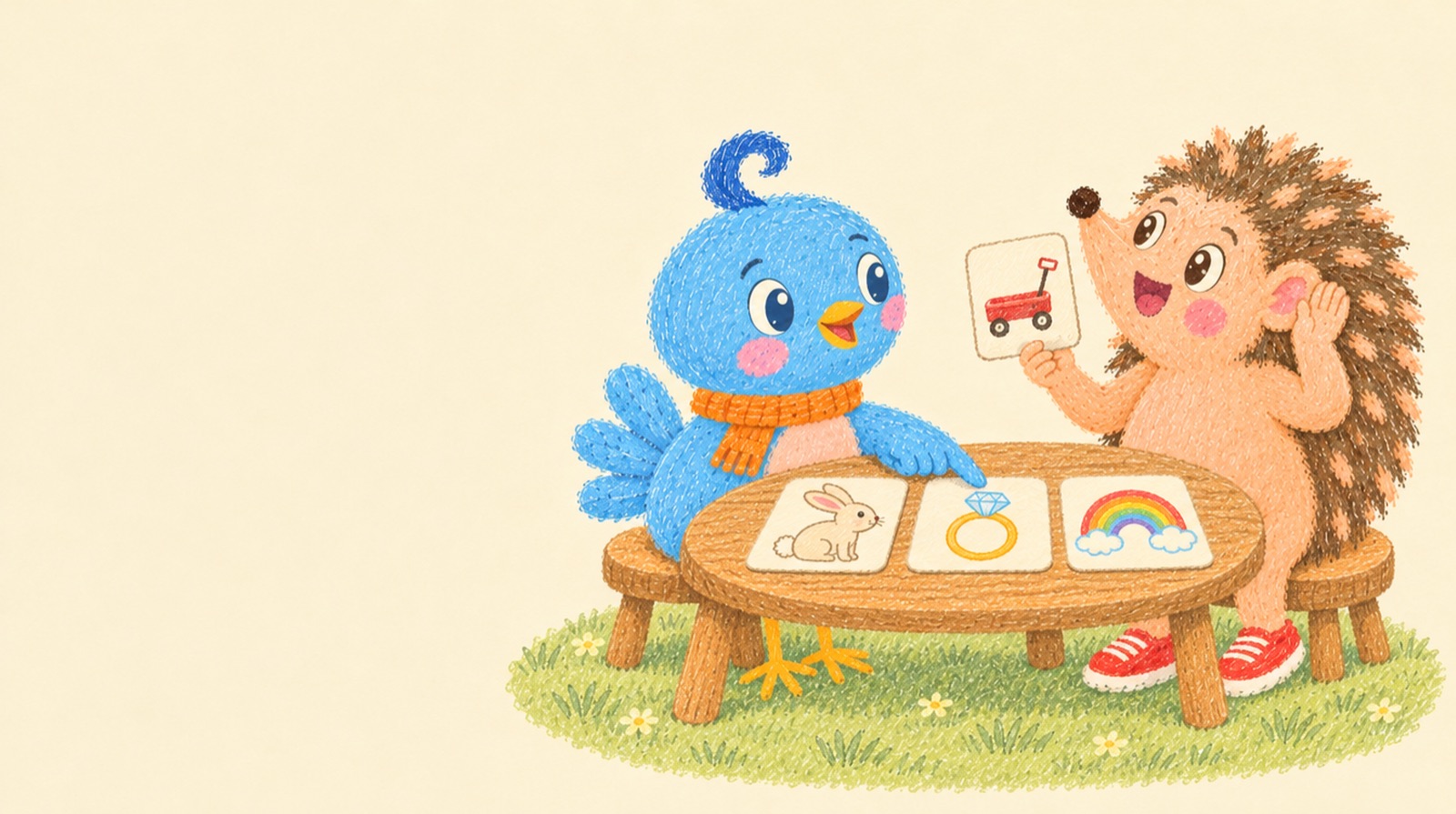
- Picture card matching: lay out R picture cards and play memory or "Go Fish." Your child says each word as they turn it over.
- Pirate talk: everyone talks like a pirate for dinner. "Arrr, pass the carrots, matey."
- Turn-taking games: give a turn in any family game for every R word. It turns a familiar game into a practice session.
- Rhymes: car, star, jar, far. Make up silly lines.
Ages 7 and up
- Category race: name as many R animals (or foods, or places) as you can in one minute.
- Read-aloud challenge: your child reads a page and listens for their own R, giving a thumbs-up when it sounds right.
- Record and listen: record a short sentence on your phone and let your child judge it. Older kids are often great at hearing their own sounds on a recording.
- Tongue twisters: "Red lorry, yellow lorry" or "Rory's rabbit ran around the rock." Go slow first.
Our therapists' product picks for R practice
You don't need to buy anything to help your child with R. Talk, books from the library and a little play go a long way. If you'd like a few tools that make practice easier, these are favorites of many pediatric speech therapists.
1. Shatterproof kids' mirrors
A child-safe acrylic mirror lets your child see whether their lips are rounding into a "w," and makes mouth games more fun. This set has several, so siblings can play too.
Why it works: mirrors give quick visual feedback for the parts of R you can see, without any risk of broken glass.
Dandat shatterproof kids' mirrors (10-pack) on Amazon
2. R sound photo cards
This deck has real photos of R words in the beginning, middle and end of words, so you can play matching, memory and "Go Fish" with exactly the sound your child needs.
Why it works: games keep kids saying R words over and over without it feeling like homework.
Super Duper Articulation Photos R Sound Fun Deck on Amazon
3. R sentence cards for older kids
Once your child can say R in single words, the next step is phrases and sentences. These cards pair R-packed sentences with actions, which keeps school-age kids moving and engaged.
Why it works: sentence-level practice helps R carry over into everyday talking, which is the real goal.
Super Duper Say and Do Action Articulation R Sounds Fun Deck on Amazon
4. A pirate game
Kids take turns sliding swords into a barrel until the pirate pops out. It's quick, a little suspenseful and perfect for an "arrr" every turn.
Why it works: pairing a fun turn with an R word ("arrr," "barrel," "sword," "pirate") builds lots of practice into a few minutes. It's labeled for ages 4 and up.
TOMY Pop Up Pirate game on Amazon
5. RRRalph by Lois Ehlert
A dog named Ralph "says" words by barking them, and kids roar with laughter. It's short, silly and full of growly R sounds.
Why it works: the growly "rrr" is a natural R model that young children love to copy.
6. Rosie Revere, Engineer by Andrea Beaty
A rhyming picture book about a girl who builds gadgets and learns that a flop is just a first try. It's packed with R words and a great message for kids working on a hard sound.
Why it works: rhymes and repetition give lots of natural R practice during read-aloud time.
Rosie Revere, Engineer on Amazon
What speech therapy for the R sound looks like
If you've never been to speech therapy, it can be hard to picture. Here's what usually happens when a child works on R with a speech-language pathologist (SLP). For a broader look, see our guide to what a pediatric speech-language pathologist does.
Step 1: The evaluation
The SLP listens to your child say lots of words and talk in conversation, checks every speech sound (not just R), looks at how the mouth moves, and asks about hearing, ear infections and family history. They'll also check whether your child can make a correct R with a little help, which is a good sign for quick progress. If you're curious about the details, here's what happens at a pediatric therapy evaluation.
Step 2: Finding the first correct R
This is the part that feels like magic to parents. Because R is hidden, therapists use cues to help a child find it: shaping it from a sound the child can already make, using a long "grrr," describing where the tongue goes in kid-friendly words, using a mirror, or using special visual feedback. The first good R often happens in a single syllable, not a word.
Step 3: Building it up
Once your child can make R on purpose, therapy moves step by step: syllables, then words, then short phrases, sentences, reading, and finally everyday conversation. Children practice many times in each session. Research on speech-sound therapy shows that lots of practice with good feedback matters.
Step 4: Carrying it over
The last step is using R without thinking about it, at home, at school and with friends. This is where you come in, with short home practice the therapist gives you.
How long does it take?
It varies a lot. Some children catch on in a few months. Others, especially older kids with a long-practiced distorted R, take longer. Your child's age, how many sounds they're working on, how often they come and how much they practice at home all make a difference. Your SLP should give you clear goals and update you as your child improves.
When to talk to a professional
Trust your instincts. You know your child best. It's a good idea to ask your pediatrician or a speech-language pathologist about an evaluation if:
- Your child is 7 or 8 and R still isn't right in everyday talk.
- Your child is 5 or 6 and has no correct Rs at all, even in "grrr" or "car."
- R is one of several sounds that are off, especially if your child also has trouble with sounds like "k," "s," "l" or "sh."
- People outside your family often can't understand your child, especially after age 4.
- Your child seems frustrated, embarrassed or is being teased about how they talk, at any age.
- Your child has had lots of ear infections, or you have any concern about hearing. Hearing should always be checked when speech sounds are slow to develop.
- Your child is also having trouble with reading or spelling. Speech-sound problems can sometimes go along with early reading challenges, and an SLP can help sort it out.
- Your child's teacher has mentioned a concern.
A note on school. Under the federal Individuals with Disabilities Education Act (IDEA), public schools have to find and evaluate children who may need special education services, including speech. You can ask your child's school for a speech evaluation in writing at no cost. Some children qualify for school speech services; others get help through a private clinic, and some families use both. If insurance is a question, we explain how insurance covers pediatric therapy in Texas.
And if you're not sure? Asking is never wrong. A short evaluation can either reassure you that your child is right on track or get help started at the best time.
FAQ
Is it normal for a 5-year-old to not say R?
Yes, it's very common. R is one of the last sounds children learn, and many 5-year-olds still say "w" for R in some or all words. If your child is otherwise easy to understand, a missing R at 5 is usually not a worry. If they have no correct Rs at all by 5 or 6, or other sounds are also off, it's reasonable to ask for a screen.
At what age should a child say R correctly?
Most children say R correctly by about age 6, and nearly all by about 7 or 8. Some types of R, like blends ("tree") and certain vocalic Rs ("fire"), can come a little later than R at the start of words ("red").
Will my child grow out of saying "w" for "r"?
Many children do, usually by about age 5 or 6. If it's still happening at 7 or 8, it's less likely to go away on its own, and speech therapy can help.
Can a tongue tie cause R problems?
It's rarely the main reason. Most children with R errors have normal tongue movement and simply haven't learned the motor pattern yet. If you're concerned, a speech-language pathologist can check how the tongue moves and talk with your pediatrician or dentist. We cover the basics in what a tongue tie looks like.
Is it too late to fix the R sound at 9, 10 or as a teenager?
No. Older children, teens and even adults can learn a clear R with speech therapy. It's often easier earlier, because the old habit has had less practice, but it's never too late to work on it.
Does my child need speech therapy for just one sound?
Not always. If your child is young and R is the only difference, an SLP may suggest waiting and rechecking. If your child is 7 or older, the error isn't changing, or your child is bothered by it, therapy for one sound is common and often quick.
Should I correct my child every time they say R wrong?
No. Constant correcting can make kids self-conscious. Instead, repeat the word back the right way with a little emphasis, and save focused practice for short, fun moments.
Can I practice R at home without a speech therapist?
Yes. Modeling, listening games and play are great for every child. If your child can't make a correct R even with your help, a speech therapist can teach the first R, and then home practice speeds everything up.
Does my child's school provide speech therapy?
Public schools must evaluate children who may need speech services, and many children qualify for help at school. You can ask for an evaluation in writing. Some families also choose a private clinic for more frequent or more targeted sessions.
The bottom line
R is late, hidden and tricky, and lots of wonderful kids say "wabbit" well into kindergarten. Most children work it out by about 6, and nearly all by 7 or 8. Until then, keep it playful: model the right sound, play listening games, roar like lions and talk like pirates. If your child is 7 or older, has several sounds that are off, is hard to understand, or is starting to feel embarrassed, that's the time to check in with a speech-language pathologist.
We're here when you're ready. Our speech-language pathologists see children at our Lake Highlands and Rockwall clinics, and getting started takes just a few minutes on our Get Started form.
Sources
- American Speech-Language-Hearing Association. Speech Sound Disorders: Articulation and Phonology (Practice Portal).
- American Speech-Language-Hearing Association. Speech Sound Disorders.
- American Speech-Language-Hearing Association. Learning Two Languages.
- Crowe K, McLeod S. Children's English Consonant Acquisition in the United States: A Review. American Journal of Speech-Language Pathology. 2020;29(4):2155-2169.
- McLeod S, Crowe K. Children's Consonant Acquisition in 27 Languages: A Cross-Linguistic Review. American Journal of Speech-Language Pathology. 2018;27(4):1546-1571.
- Smit AB, Hand L, Freilinger JJ, Bernthal JE, Bird A. The Iowa Articulation Norms Project and Its Nebraska Replication. Journal of Speech and Hearing Disorders. 1990;55(4):779-798.
- Coplan J, Gleason JR. Unclear Speech: Recognition and Significance of Unintelligible Speech in Preschool Children. Pediatrics. 1988;82(3):447-452.
- Flipsen P Jr. Emergence and Prevalence of Persistent and Residual Speech Errors. Seminars in Speech and Language. 2015;36(4):217-223.
- Lee ASY, Gibbon FE. Non-speech Oral Motor Treatment for Children with Developmental Speech Sound Disorders. Cochrane Database of Systematic Reviews. 2015;(3):CD009383.
- U.S. Department of Education. Individuals with Disabilities Education Act (IDEA).
This article is for education and is not a diagnosis or medical advice. If you have concerns about your child's speech, language, hearing or development, talk with your pediatrician or a speech-language pathologist.