

What a tongue tie looks like: signs parents and pediatricians miss

Most parents who search what does tongue tied look like want a picture. The more useful answer is this: how the tongue moves matters more than how it looks. Plenty of babies have a visible band under the tongue and feed well.
Tongue tie, or ankyloglossia, shows up in about 1.7% to 10.7% of newborns, based on three studies cited by the American Academy of Pediatrics (AAP). The range is wide because experts still use different definitions.
This guide was clinically reviewed by an Oaklin Lane feeding therapist. Our feeding team includes speech-language pathologists and occupational therapists who watch babies suck, swallow, and breathe through real feeds. Below, you will learn the visible signs, the feeding signs, what counts as normal, how to run a simple home screen, and who to call next.
What does tongue tied look like up close
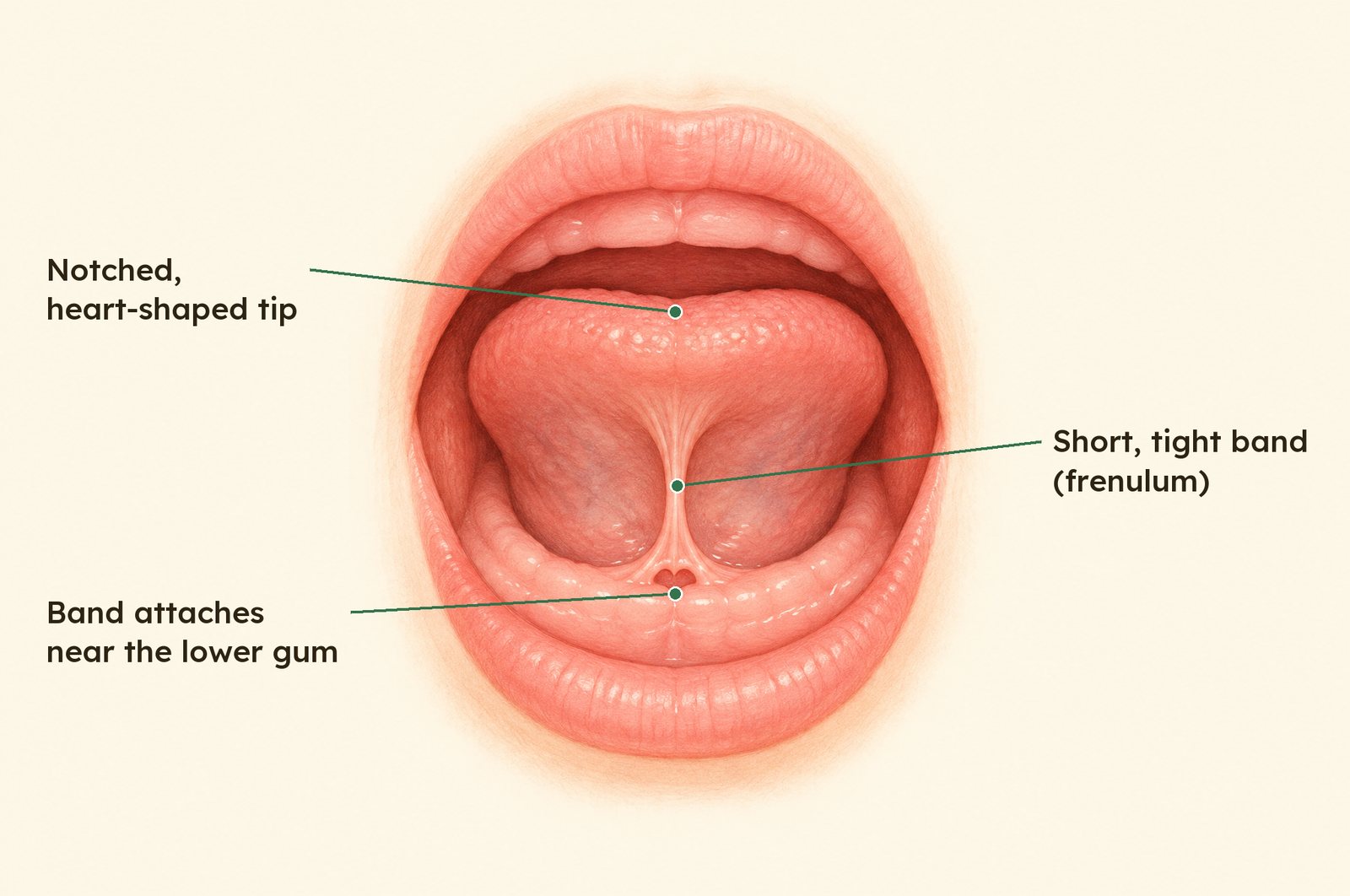
A tongue tie is a lingual frenulum, the thin band under the tongue, that is short, tight, or attached close to the tip. Up close, you check three things: the shape of the tip, where the band attaches, and how far the tongue moves.
Heart-shaped or notched tip
When a baby with a tight band lifts or sticks out the tongue, the band can pull the middle of the tip down. The tip then looks notched or heart-shaped. The NHS lists this shape as a key visible sign. Look while the tongue stretches, since the pull shows best during movement.
Where the frenulum attaches
Look under the tongue when your baby cries or yawns. Those are the moments the mouth opens widest on its own. The NHS feeding guide warns that a tie can be hard to spot. Ties range from mild to severe. In severe cases, the tongue is almost fully joined to the floor of the mouth.
A band that attaches at or near the tip, or high on the lower gum ridge, is the easiest kind to see. A band set farther back is harder to judge by eye.
Movement limits
Movement tells you the most. A tied tongue may struggle to lift toward the roof of the mouth, move side to side, or reach past the lower gum and lip. StatPearls, a medical reference on the NCBI Bookshelf, names limited forward reach as a core exam finding.
The AAO-HNS expert panel defines ankyloglossia as limited tongue mobility caused by a restrictive frenulum. So movement sits at the center of the definition. Appearance alone settles little.
What does a tongue tie look like in a baby?
A tongue tie in a baby often looks like a short, tight band under the tongue that holds the tip down. When the baby cries or sticks the tongue out, the tip may look notched or heart-shaped. The tongue may barely lift, move side to side, or reach past the lower gum.
Signs you can see:
- A notched or heart-shaped tip when the tongue lifts or stretches
- A band attached at or near the tip of the tongue
- A band that tugs on the lower gum ridge when the tongue lifts
- A tongue that stays low in the mouth while the baby cries
- A tongue that stops at the gum line when the baby tries to stick it out
One sign on its own means little. Clinicians weigh what they see against how feeding is going. That is where the real answer lives.
Tongue tied infant symptoms during feeds
Feeding is where a tie matters. Tongue tied infant symptoms show up as trouble latching, noisy or messy feeds, and slow weight gain. The NHS lists the signs below.

Signs in the baby
- Trouble latching onto the breast or bottle, or staying on
- Clicking sounds during feeds
- Heavy dribbling of milk
- Coughing or choking while feeding
- Long, frequent feeds with small amounts each time
- Seeming hungry all the time
- Slow weight gain or weight loss
These symptoms of tongue tied babies overlap with many other feeding problems. A clicking sound, for example, can also come from positioning or attachment. That overlap is why one symptom calls for a closer look, and a closer look comes before any decision.
Signs in the parent
Breastfeeding parents may notice sore nipples or painful, swollen breasts. That pain is real and deserves care.
Still, the 2024 AAP clinical report says nipple pain alone is too little to diagnose a symptomatic tongue tie, as the ASHA Leader summarized. The AAP also says most breastfeeding difficulties, pain included, come from other causes. Latch support and pain management come first.
Tongue tied vs normal anatomy
A big part of answering what does tongue tied look like is knowing what normal looks like. Several mouth features look worrying and are completely normal. Knowing tongue tied vs normal anatomy can spare a family stress and an unneeded procedure. The 2024 AAP clinical report is clear on each item below.
| What you see | What it is | What the AAP report says |
|---|---|---|
| Sucking blisters on the lips | Small calluses from frequent sucking | Normal. A sign of a hard-working feeder. |
| Upper lip frenulum | The band joining the upper lip to the gum | A normal structure. Surgery for it is advised against. |
| Cheek (buccal) frena | Small bands inside the cheeks | Normal structures. Surgery for them is advised against. |
| "Posterior tongue tie" | A label for a band set farther back | Too poorly defined to guide surgery. |
| A visible frenulum with easy feeds | A common variation in mouth structure | Needs no treatment. |
That last row matters most. Babies with a tie who feed normally need no treatment. The AAP report calls ankyloglossia a normal variation in oral structure, and uses "symptomatic ankyloglossia" for a tight band paired with feeding problems that support has yet to fix (ASHA Leader).
How to check for a tongue tie at home
If you want to answer what does tongue tied look like for your own baby, the simplest way to learn how to check for a tongue tie at home is to borrow the four checks from the Bristol Tongue Assessment Tool (BTAT). It gives you clear words for what you see. A trained clinician still makes the diagnosis.
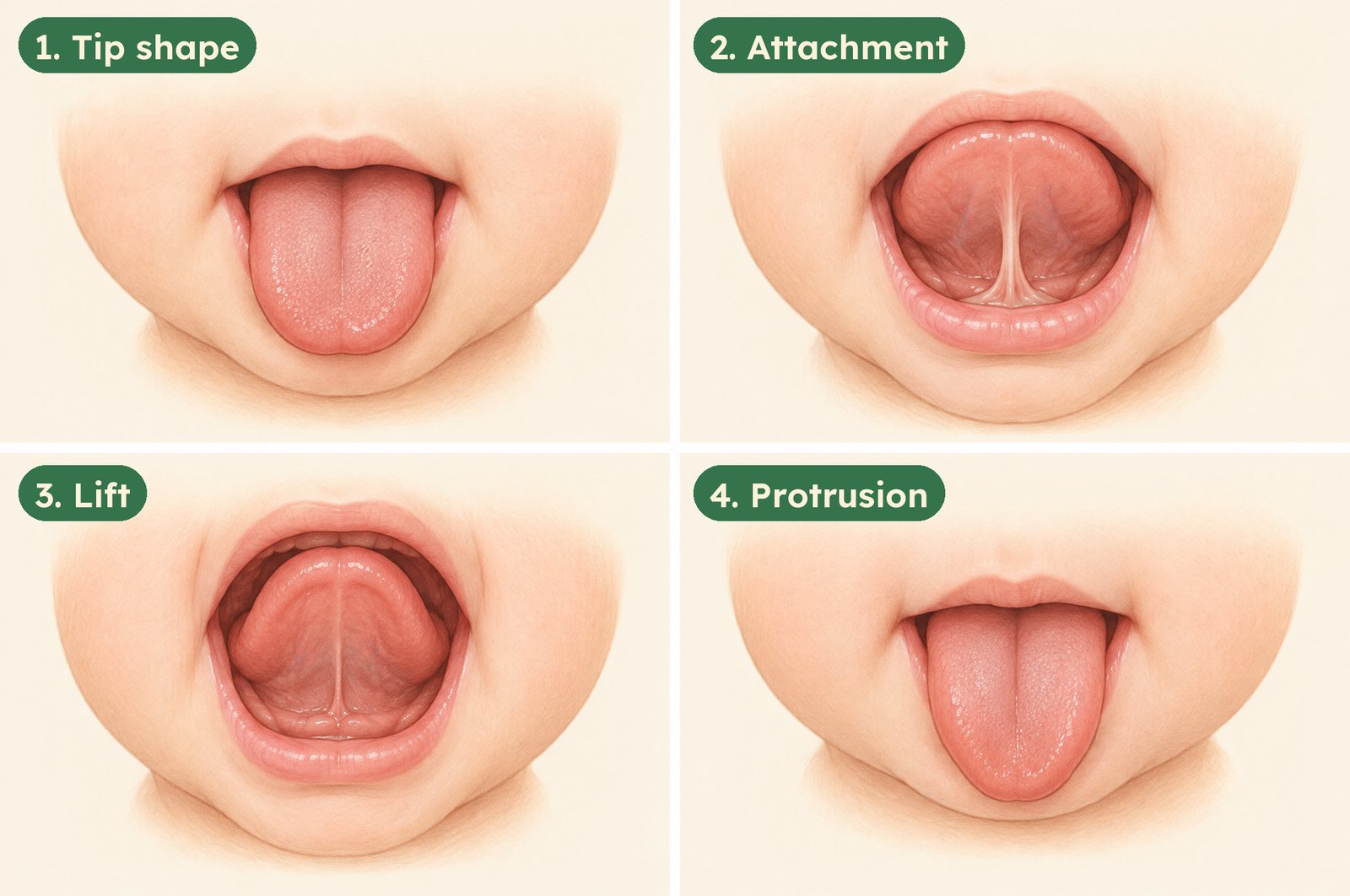
Researchers in Bristol, England, published the BTAT in 2015 and tested it with midwives. It scores four features from 0 to 2 each, for a total of 0 to 8. Use good light, clean hands, and a calm moment, or watch during a cry or yawn.
- Tip shape. Look at the tip as the tongue stretches. A heart-shaped tip sits at the low end. A rounded tip sits at the high end.
- Attachment. Find where the band meets the lower gum. A band fixed high on the gum ridge sits at the low end. A band joined farther back, on the floor of the mouth, sits at the high end.
- Lift. With the mouth wide open, often during a cry, watch how high the tongue rises. Full lift toward the roof of the mouth sits at the high end.
- Protrusion. Watch how far the tongue reaches forward. A tip that extends over the lower lip sits at the high end.
A total of 8 matches typical tongue function. Totals of 0 to 3 point to a large drop in tongue function. Scores in between call for a closer look, often with feeding support first (Ingram et al., 2019).
Treat your score as a screen. Write it down, take a short video if you can, and bring both to your pediatrician or feeding therapist. A screen helps you describe what you see. Diagnosis needs a full exam and a watched feed.
Why the signs get missed or overcalled
Tongue ties get missed when nobody checks movement. They get overcalled when every feeding problem gets blamed on the frenulum. Both happen.
How a tie gets missed
A resting tongue can look ordinary, since the pull shows during movement. That is why a photo search for what does tongue tied look like can mislead. A quick look during a busy newborn visit may miss what a cry or yawn reveals. The NHS notes a tie is easy to overlook for this reason.
How a tie gets overcalled
Feeding problems have many causes, including latch, positioning, milk supply, reflux, airway issues, and the shape of the jaw or palate. StatPearls advises ruling out craniofacial, nasal, airway, and reflux causes first.
The 2020 AAO-HNS consensus statement agreed that in some communities, infants and children are being over-diagnosed with ankyloglossia. The same panel agreed a significant number are having unnecessary surgery on the frenulum.
The numbers back this up. Frenotomy procedures rose 866% from 1997 to 2012, according to a national study by Walsh and colleagues. In a 2019 Massachusetts Eye and Ear study, each referred newborn first had a full feeding evaluation with a pediatric speech-language pathologist. After that evaluation, about 63% (62.6%) of the referred newborns went without surgery (Harvard Medical School).
Signs of tongue tied in toddlers
In toddlers, the signs of tongue tied kids show up in daily tasks. Johns Hopkins Medicine lists trouble licking the lips or sweeping food off the teeth, plus trouble lifting the tongue or moving it side to side.
Speech is a separate question. The AAO-HNS panel agreed a tongue tie typically leaves speech unaffected, and encouraged a speech pathologist consult before any release done for speech concerns. Speech worries deserve their own check with a speech-language pathologist.
Who checks feeding function
A team checks feeding function. The AAP recommends that pediatricians work with lactation consultants, speech-language pathologists, and other specialists, and try nonsurgical options first (HealthyChildren.org).
The AAP reserves frenotomy, the procedure that releases the band, for babies with significant functional impairment after nonsurgical support has failed. Here is how the roles usually split:
- Pediatrician: checks growth and weight, examines the mouth, and rules out other medical causes.
- Lactation consultant: works on latch, positioning, and milk transfer at the breast.
- Feeding therapist (SLP or OT): evaluates suck, swallow, and breathing during a real feed, plus oral-motor strength and coordination.
- Release provider: a medical or dental provider who performs a frenotomy when the team agrees one is warranted.
What our feeding therapists look for
Our feeding therapists look at both the hardware and the software of eating: the muscles of the mouth, and how the nervous system coordinates suck, swallow, and breath. A feeding evaluation watches a real feed from start to finish. You can read a step-by-step walkthrough in our guide to a pediatric feeding clinic.
To be plain about our role: Oaklin Lane assesses feeding function and provides pediatric feeding therapy. Releases are a medical procedure, so we refer families to a medical or dental provider when one looks warranted, and we support feeding before and after.
Frequently Asked Questions
What does tongue tied look like in a newborn?
A tongue tied newborn often has a short, tight band under the tongue that pulls the tip into a notch or heart shape. The tongue may stay low, move little side to side, and stop at the gum line. Check when your baby cries or yawns, when the mouth opens widest.
What are the signs of a tongue tie in newborn babies?
The main signs of a tongue tie in newborn babies are trouble latching, clicking during feeds, heavy dribbling, long or frequent feeds, and slow weight gain. Many of these signs have other causes too, so a feeding evaluation helps sort them out.
How to check tongue tie without a doctor?
You can screen at home with the four Bristol checks: tip shape, attachment, lift, and protrusion, each scored 0 to 2. A total of 8 matches typical function. Bring your notes to a pediatrician or feeding therapist, since diagnosis needs a full exam and a watched feed.
Does every tongue tie need cutting?
No. The AAP says babies with a tie who feed normally need no treatment, and nonsurgical support should come first. A release is reserved for significant feeding problems that support has failed to fix.
Next step
Three things to keep from this guide. Movement matters more than looks. Normal features like sucking blisters and lip bands need no fix. A feeding evaluation gives you a clear answer before any procedure.
If feeds feel hard and you see some of these signs, start with our Get Started intake. The introductory form takes about 10 minutes and starts insurance verification. From there, our team connects with you about what you are noticing and what comes next.
Every baby is different. Feeding therapy can help many families, and results depend on the cause, the child, and practice at home. Good neighbors show up, and we are here when you are ready.
Sources
- American Academy of Pediatrics via HealthyChildren.org, "AAP Report Addresses Rise in Tongue-Tie Diagnoses for Breastfeeding Concerns," July 29, 2024
- Thomas J, Bunik M, Holmes A, et al. "Identification and Management of Ankyloglossia and Its Effect on Breastfeeding in Infants: Clinical Report." Pediatrics, 2024;154(2)
- LaManna S. "New AAP Resources Offers Insights on Breastfeeding and Ankyloglossia." The ASHA Leader, July 31, 2024
- NHS, "Tongue-tie" (conditions page)
- NHS Start for Life, "Tongue-tie" (breastfeeding challenges)
- Becker S, Brizuela M, Mendez MD. "Ankyloglossia." StatPearls, NCBI Bookshelf, updated June 9, 2023
- Messner AH, Walsh J, Rosenfeld RM, et al. "Clinical Consensus Statement: Ankyloglossia in Children." Otolaryngology-Head and Neck Surgery, 2020;162(5)
- Walsh J, Links A, Boss E, Tunkel D. "Ankyloglossia and Lingual Frenotomy: National Trends in Diagnosis and Management in the United States, 1997-2012." Otolaryngology-Head and Neck Surgery, 2017
- Harvard Medical School News, Mass Eye and Ear study (Caloway C, Hersh C, Hartnick C, et al.), JAMA Otolaryngology-Head and Neck Surgery, July 11, 2019
- Johns Hopkins Medicine, "Tongue-Tie (Ankyloglossia)"
- Ingram J, Johnson D, Copeland M, Churchill C, Taylor H, Emond A. "The development of a tongue assessment tool to assist with tongue-tie identification." Arch Dis Child Fetal Neonatal Ed, 2015;100(4):F344-F349
- Ingram J, Copeland M, Johnson D, Emond A. "The development and evaluation of a picture tongue assessment tool for tongue-tie in breastfed babies (TABBY)." Int Breastfeed J, 2019;14:31