

Auditory processing disorder vs ADHD: how to tell the difference

APD and ADHD can look alike from the outside, but they are two different problems. Auditory processing disorder (APD) is a listening problem that shows up with sound. ADHD affects attention in every setting and with every sense, including sight and touch.
This guide is for parents trying to sort out whether their child's struggles look more like auditory processing disorder or ADHD, or both. It compares the two side by side: who tests for each, what the tests look for, which signs point which way, and why the answer is often "both." It is a comparison guide. Only a qualified professional can make either diagnosis.
A licensed clinician on our team reviewed this guide before it went live. Our clinical team has served more than 10,000 kids over 22 years, and our speech-language pathologists see listening and attention questions often.
What is the difference between auditory processing disorder and ADHD?
An audiologist diagnoses APD, a problem with how the brain processes sound. A pediatrician, psychologist, or psychiatrist diagnoses ADHD, a problem with attention, activity, and impulse control across every setting. APD affects listening. ADHD affects attention to everything. The two often show up in the same child, so testing for one can point to the other.
The clearest dividing line is the senses involved. Researchers Chermak, Hall, and Musiek described APD as a sensory deficit restricted to hearing. In ADHD, inattention shows up in listening tasks too, but also in visual and hands-on tasks, like copying from the board or finishing a puzzle.
So one useful question at home: does your child lose focus only when sound is involved, or across the board? A child who tunes out during a noisy story time but stays locked in on a quiet drawing may be showing a listening pattern. A child who drifts off during the story, the drawing, and the puzzle may be showing an attention pattern. Only testing can confirm either one.
Two classroom snapshots
Picture two second graders. The first follows along well in a quiet reading group but misses half the directions when the class gets loud, and asks "what?" a lot. The second drifts during reading group, leaves worksheets half done in a silent room, and gets up often. Both look inattentive to a busy teacher.
The first pattern leans toward listening. The second leans toward attention. Plenty of children show a mix of both. These snapshots are a way to describe what you see to a professional, and the diagnosis itself still comes from testing.
ADHD vs APD: side-by-side comparison
APD and ADHD are diagnosed by different professionals, with different tests, at different ages. Here is how they compare.
| APD | ADHD | |
|---|---|---|
| Who diagnoses | An audiologist | A pediatrician or other primary care provider, psychologist, or psychiatrist |
| How it is tested | Hearing test first, then a central auditory test battery of listening tasks | Symptom reports from parents and teachers, rating scales, and DSM-5-TR criteria, after ruling out other causes |
| Core signs | Trouble hearing in noise, following spoken directions, and telling similar sounds apart | Inattention, hyperactivity, or impulsivity across home, school, and other settings |
| Age at evaluation | Screeners from about age 5. Full testing calls for extreme caution at age 8 and under. | The AAP guideline covers ages 4 to 18 |
How APD is diagnosed
The American Speech-Language-Hearing Association (ASHA) says APD is diagnosed by an audiologist. The audiologist first rules out hearing loss, then gives a battery of listening tests. A common rule is scores at least 2 standard deviations below average on 2 or more tests. We walk through every step in our guide to auditory training for APD.
How ADHD is diagnosed
The CDC says ADHD can be diagnosed by a pediatrician, psychologist, or psychiatrist. The American Academy of Pediatrics guideline recommends evaluating children ages 4 to 18 who have school or behavior problems along with inattention, hyperactivity, or impulsivity.
Under the DSM-5-TR criteria the CDC summarizes, a child up to age 16 needs 6 or more symptoms of inattention or hyperactivity-impulsivity. The symptoms must last at least 6 months, show up in 2 or more settings, and include several that started before age 12.
Age is one of the biggest practical differences. An ADHD evaluation can start as early as age 4. Full APD testing is usually done later, because the 2010 American Academy of Audiology guidelines urge extreme caution with behavioral APD testing at age 8 and under. That timing gap is one reason an ADHD question often gets answered first, with APD questions coming later.
Signs that point toward APD or ADHD
When professionals rank the signs, APD and ADHD look far more different than they seem at first. The overlap sits mostly in one place: inattention.
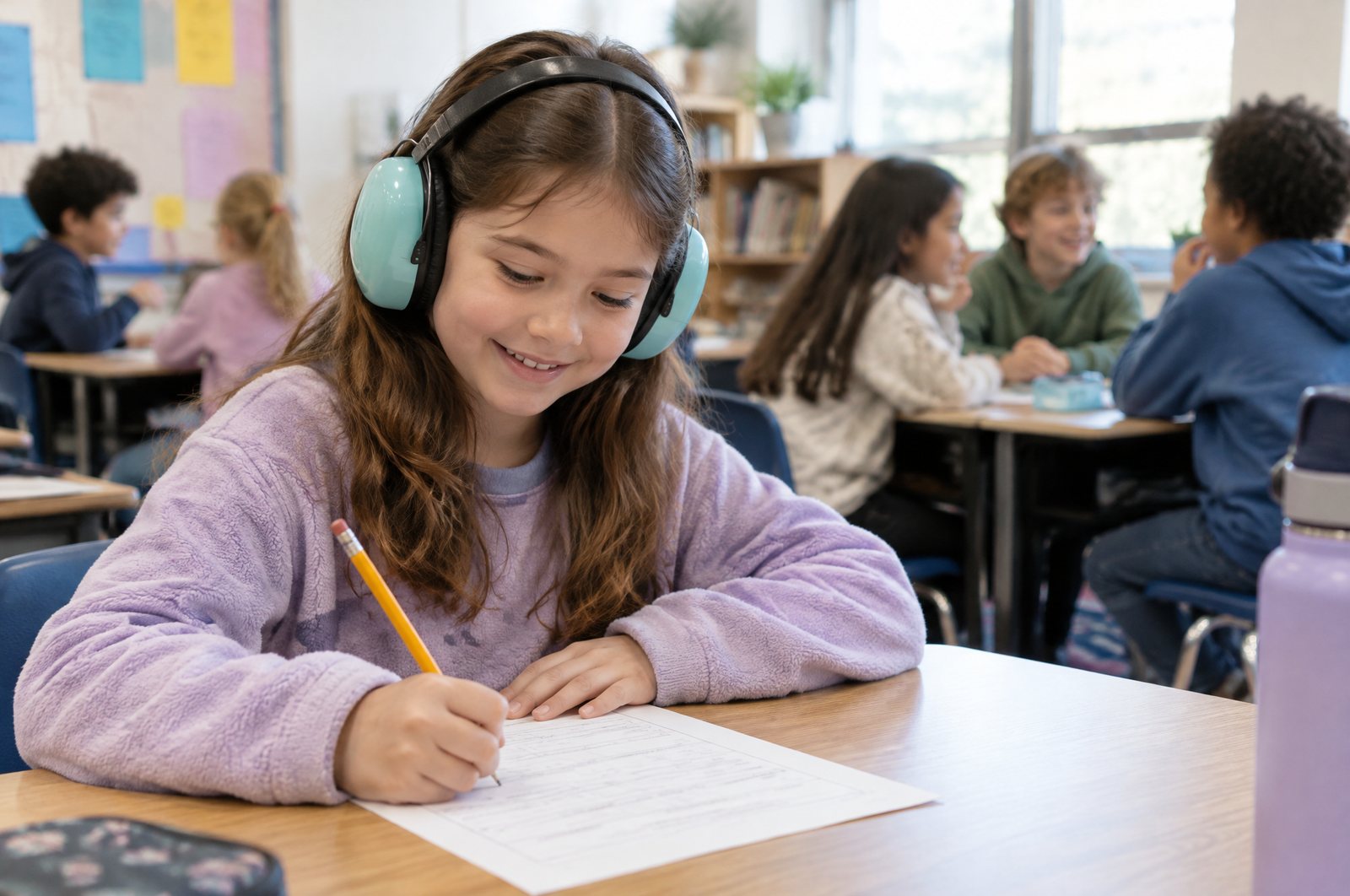
Auditory processing vs ADHD: what experts rank
In a 1998 study, pediatricians ranked 41 behaviors for ADHD and audiologists ranked the same behaviors for APD. Summaries of this research list these near the top for each:
- ADHD, ranked by pediatricians: hyperactivity, restlessness, impulsivity, and interrupting others.
- APD, ranked by audiologists: trouble hearing in background noise and trouble following spoken directions.
Only two of the most-cited behaviors were judged typical of both: inattention and distractibility. That is why the two get mixed up so often. The shared signs are the ones parents and teachers notice first.
Notes worth keeping at home before any appointment:
- Does focus drop mainly when it is noisy, or in quiet settings too?
- Does your child ask for repeats, or seem to miss whole parts of what was said?
- Is your child restless, impulsive, or quick to interrupt, even during quiet tasks?
- Do teachers see the same patterns you see at home?
Auditory attention deficit in the inattentive type
The comparison gets trickier with the inattentive type of ADHD, where there is little hyperactivity. A child who quietly daydreams can look a lot like a child with an auditory attention deficit.
A 2002 follow-up study compared APD with this inattentive type, using 58 behaviors. None of the top-ranked behaviors were shared between the two lists. The professionals saw each condition as its own set of signs.
For parents, that is useful news. Even when the outside looks the same, a quiet, dreamy child, the details usually differ. Write down when the drifting happens and what is going on around your child at the time. Those notes help the professionals sort out which pattern they are seeing.
Signs that lean toward a listening problem include asking for things to be repeated, poor listening skills, and trouble telling similar sounds apart, a skill audiologists check in the APD test battery.
APD and ADHD together: how often they overlap
APD and ADHD often show up together. For many families, the real answer to "auditory processing disorder or ADHD?" is both.
In a 1994 study of 30 children diagnosed with central auditory processing disorder, 50% also met the criteria for ADHD. That rate was much higher than in children overall. Some children with APD showed no ADHD behaviors at all, which is a reminder that the two are separate conditions.
The overlap runs the other way too. ASHA notes that children with attention, cognition, or language diagnoses are more likely to have a coexisting APD diagnosis. So a central auditory processing disorder ADHD combination is common enough that a good workup keeps both in mind.
An ADHD auditory processing disorder pairing also changes how test scores should be read. A StatPearls review notes that an APD diagnosis should take cognition and memory into account, so the whole child matters, beyond any single score.
This matters for planning. If a child has APD and ADHD together, supports for only one may leave the other untouched. Each condition has its own professionals and its own tools.
When a child has ADHD and auditory processing disorder together, the plan often blends supports. Classroom listening help, like seating near the teacher and written directions, sits alongside attention supports from the ADHD team. Parents who understand how ADHD and auditory processing interact can ask sharper questions at each visit.
Why ADHD auditory processing results can mislead
Attention affects listening tests. A child who struggles to stay focused may score low on an auditory test even when their auditory processing is fine, so ADHD auditory processing results need careful reading.
A StatPearls review notes that children with ADHD often perform poorly on central auditory tasks and that the conditions tend to produce similar scores on cognitive, communication, and auditory tests. The authors add that the listed behaviors can come from more than APD, so a team approach is needed to tell them apart.
What one medication study found
One small study shows how the two can separate. In a 2000 double-blind, placebo-controlled study, 32 children with both ADHD and APD were tested once on a stimulant medication and once on a placebo. Scores on an auditory attention test improved with the medication. Scores on three central auditory tests, including speech-in-noise, stayed the same.
This is research only, from one small group of children. It is shared here because it suggests attention and auditory processing are measured as separate skills. It is no guidance on treatment. Questions about medication belong with your child's doctor.
Many parents search for audio processing ADHD answers because they have seen both labels in school reports. The research above is the reason careful clinicians test attention and listening separately, and look at the results side by side.
If your child has already had one evaluation, ask the team two questions. Were attention and listening tested separately? And could one condition have affected the scores for the other? Clear answers help you know whether a second opinion or a second type of test makes sense.
Hearing and vision come first
The CDC says an ADHD evaluation includes a medical exam with hearing and vision tests, to rule out other problems that look like ADHD. A child with a mild hearing or vision problem can look inattentive for simple reasons.
Who to see and in what order
Start with your pediatrician. From there, the usual path is a hearing test, then an audiologist for APD questions and a psychologist or your pediatrician for ADHD questions.
- Step 1, pediatrician: share what you see at home and school, and ask about a medical exam with hearing and vision checks.
- Step 2, hearing test: rule out hearing loss before any APD testing.
- Step 3, audiologist: central auditory testing if listening concerns remain.
- Step 4, psychologist or pediatrician: an ADHD evaluation with rating scales from home and school.
A speech-language pathologist (SLP) works alongside these steps. SLPs work on language and listening skills, like following directions, vocabulary, and sound awareness. Our guide to auditory training for APD covers APD testing and therapy in detail.
What to bring to appointments
- Teacher notes or report card comments about listening, focus, and behavior.
- Specific examples, like the setting, the noise level, and what your child missed.
- Your child's hearing history, including ear infections or ear surgeries, which ASHA lists in the APD case history.
- Any past test results, rating scales, or school evaluations.

Oaklin Lane leaves diagnosis of both APD and ADHD to the right specialists. Our team treats children with ADHD and refers families to audiology or to their doctor when testing is needed.
Patterns that prompt a referral at Oaklin Lane
During a speech evaluation, our SLPs note when a child's struggles track closely with sound, like doing well one-on-one in a quiet room but falling apart with background noise. They also note when focus slips across every type of task, quiet or loud. Either pattern leads to a conversation with the family about the right next referral, explained at the caregiver conference.
Frequently Asked Questions
Can a child have APD and ADHD at the same time?
Yes. In one study of 30 children with central auditory processing disorder, 50% also met ADHD criteria. ASHA also notes that children with attention diagnoses are more likely to have a coexisting APD diagnosis.
Is central auditory processing disorder ADHD under another name?
No. APD is a listening problem diagnosed by an audiologist, while ADHD affects attention across all the senses and is diagnosed by a medical or mental health provider. They often co-occur, but experts rank their core signs quite differently.
Who tests for ADHD hearing issues?
Your pediatrician can start with a medical exam that includes a hearing test. If listening problems remain after hearing is cleared, an audiologist tests for APD.
Does ADHD affect audio processing?
ADHD can affect scores on listening tests, because attention plays a big part in them. That is why audiologists and ADHD specialists both look at the full picture before reaching an answer.
Next step
Two things to take with you. APD is a listening problem tested by an audiologist, and ADHD is an attention problem tested by a pediatrician, psychologist, or psychiatrist. Many children have both, so ask about each before you settle on one answer.

Want to go deeper? Our sensory integration ADHD primer explains how sensory needs can show up alongside attention. Our guide to auditory training for APD explains APD testing and therapy, and our guide to occupational therapy and ADHD covers attention and daily skills.
When you are ready, fill out our 10-minute Get Started form. Oaklin Lane's team will talk with you about what you are noticing, check your benefits, and schedule an evaluation, usually within 2 weeks.
Every child is different. Therapy can help, and results vary from child to child. This guide is general information and carries no guarantee of a specific outcome. Talk with your child's doctor about your child's needs.
Sources
- ASHA Practice Portal, Central Auditory Processing Disorder
- CDC, Clinical Care for ADHD (AAP guideline and DSM-5-TR criteria)
- CDC, Diagnosing ADHD
- Smith (2008), Louisiana Tech University dissertation, citing Chermak, Hall, and Musiek (1999)
- Chermak, Somers, and Seikel (1998), Behavioral signs of CAPD and ADHD, J Am Acad Audiol 9(1)
- Chermak, Tucker, and Seikel (2002), Behavioral characteristics of APD and ADHD predominantly inattentive type, J Am Acad Audiol 13(6)
- Riccio et al. (1994), Comorbidity of CAPD and ADHD, J Am Acad Child Adolesc Psychiatry
- Aristidou and Hohman, Central Auditory Processing Disorder, StatPearls (updated March 1, 2023)
- Tillery, Katz, and Keller (2000), Effects of methylphenidate on auditory performance, J Speech Lang Hear Res 43(4)