

Occupational therapy for ADHD: what it does that medication does not

Parents who look into occupational therapy and ADHD usually have one question first: if my child takes medication, why add therapy? The short answer is that the two do different jobs. Medication, managed by your child's prescriber, treats symptoms. Occupational therapy (OT) builds the daily skills a child uses to get dressed, finish a worksheet, and handle a hard transition.
That difference matters for a lot of families. About 7.1 million US children ages 3 to 17 have ever been diagnosed with ADHD, based on the 2022 National Survey of Children's Health (CDC).
This guide was clinically reviewed by a licensed Oaklin Lane occupational therapist. Our OTs support kids with attention, regulation, and daily-skill needs in our therapy gyms. Below, you will see what OT targets, what a session looks like, where it sits next to medication, and the signs that point to an OT evaluation.
How does occupational therapy help a child with ADHD?
Occupational therapy helps a child with ADHD build the everyday skills that attention and impulse control make hard. An OT teaches calming and alerting strategies, practices routines and motor skills through play, and adjusts the space around the child. The goal is a child who can stay on task and take part at home and school.
The American Occupational Therapy Association (AOTA) describes OT practitioners teaching alerting and calming strategies to students with ADHD, and changing the environment to help them stay on task. Common ADHD OT goals include:
- Following a morning or bedtime routine with fewer reminders
- Starting, sticking with, and finishing a short task
- Neater, faster handwriting
- Dressing, buttons, zippers, and shoe tying
- Calming down after a big feeling, and getting alert when energy is low
- Waiting, taking turns, and joining group play
- Moving through transitions with fewer meltdowns
If you are asking does occupational therapy help with ADHD, this list is the honest answer: it can help with daily tasks like these. Each goal ties to something the child does every day.
Occupational therapy and ADHD: the skills OT targets
OT for ADHD usually works on three skill areas: executive function, motor coordination, and self-regulation. Parents who ask does occupational therapy help ADHD are usually asking about these three areas. Most kids need some mix of all three.
Executive function and routines
Executive function is the brain's management system. It covers planning, starting tasks, remembering steps, shifting between activities, and checking your own work. Kids with ADHD often know what to do and still struggle to do it in order.
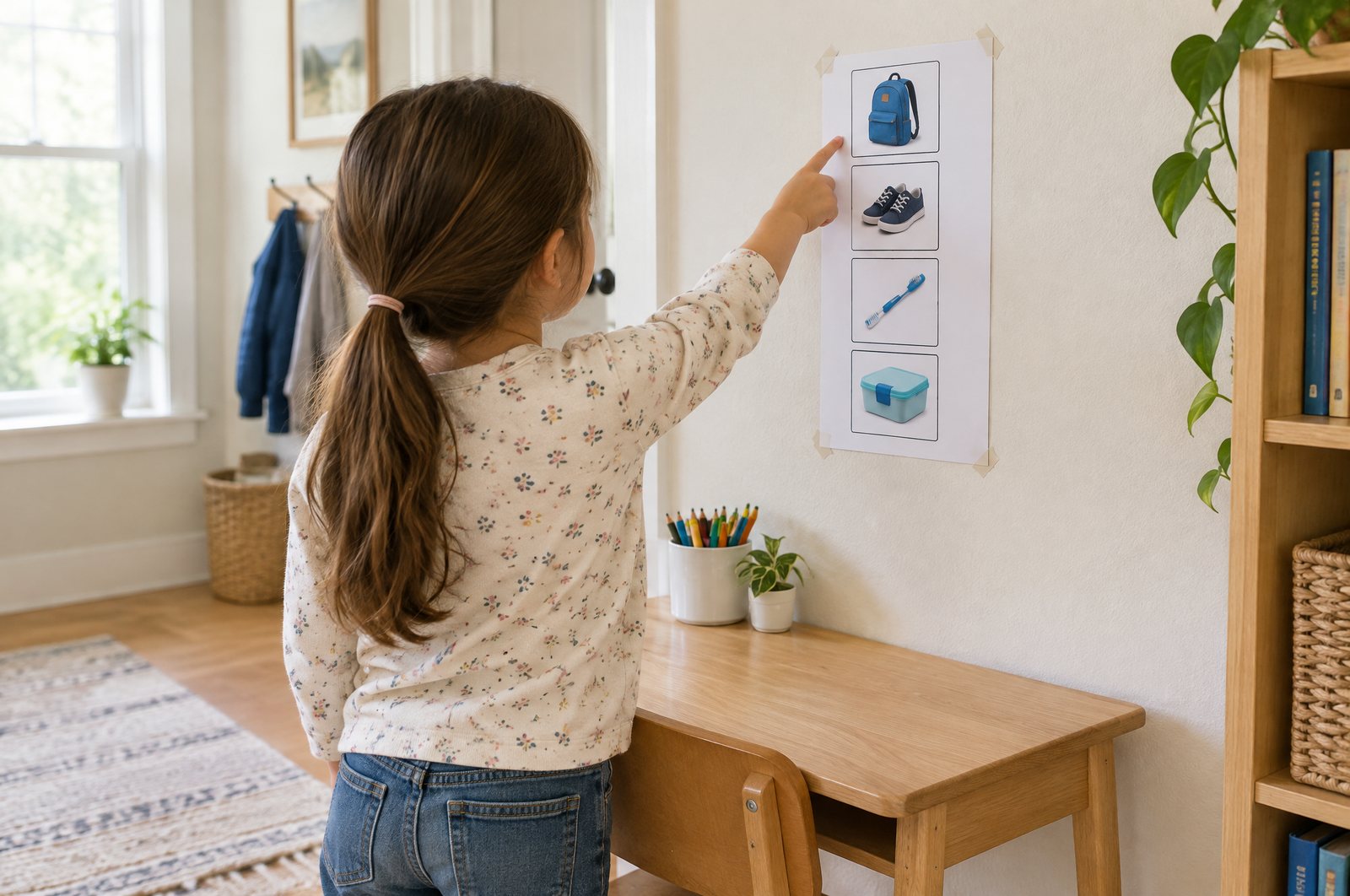
Research on occupational therapy and ADHD centers here. A 2026 scoping review of 11 studies found that most OT interventions for children with ADHD aimed to improve executive functions (Rodrigues and Sposito). In practice, that looks like picture schedules, step-by-step checklists, timers, and games that build working memory and planning.
Take a morning routine. "Get ready for school" is one instruction with a dozen hidden steps. An OT breaks it into a short picture list: bathroom, clothes, shoes, backpack. The child practices the list in session, then at home. Over time, the parent gives fewer prompts and the list does more of the work.
The same idea works for homework. A child who freezes at a full worksheet may do fine with one row at a time, a timer, and a short movement break between rows.
Motor coordination and handwriting
Many kids with ADHD also struggle with coordination. ADHD and developmental coordination disorder (DCD) co-occur in up to 50% of cases in clinical samples, according to a 2022 review (Lino and Chieffo). These are the kids who trip often, avoid ball games, or tire fast when writing.
Handwriting is a common OT target. A 2020 systematic review in the American Journal of Occupational Therapy found strong evidence for therapeutic practice in handwriting intervention (Grajo et al.). That means short, repeated, coached practice of letter forms, spacing, and sizing. A session might use five to ten minutes of writing on lined paper with clear start points, followed by a quick check of what went well. Our physical and occupational therapies page lists the motor and handwriting needs OTs support.
Self-regulation and social play
Self-regulation is the skill of noticing your body and feelings and bringing them back to a workable level. An OT helps a child spot early signs, like a racing body or clenched fists, and try a tool that works for them.
Tools fall into two groups. Calming strategies bring a busy body down: slow breathing, a quiet corner, pushing against a wall, or a tight squeeze. Alerting strategies wake up a tired or foggy body: jumping, a quick walk, a cold drink, or a crunchy snack. Kids with ADHD often need both at different times of day, so the OT helps the child and parent learn which tool matches which moment.
Social play builds on that. A 2020 systematic review found moderate evidence for social skills interventions that include peers, for children with ADHD (Fox et al.).
What ADHD OT looks like in a session
ADHD occupational therapy follows a simple path: an evaluation, clear goals, play-based practice, and carryover at home. Here is how each step usually works.
- Evaluation. The OT talks with you about what you are seeing, reviews history, and watches your child move, write, play, and handle tasks. Standardized tools may be part of it.
- Goals. Together you pick a few goals tied to daily life, like "gets dressed with two reminders or fewer."
- Play-based practice. Sessions use movement, games, and hands-on tasks so the work feels like play. The challenge rises a little at a time.
- Carryover at home. You leave with a few strategies to use in real routines, because skills stick when they get practiced between sessions.
A sample session in the gym
Here is an illustrative example of how a 7-year-old's session might run. It shows the structure. Your child's plan will differ.
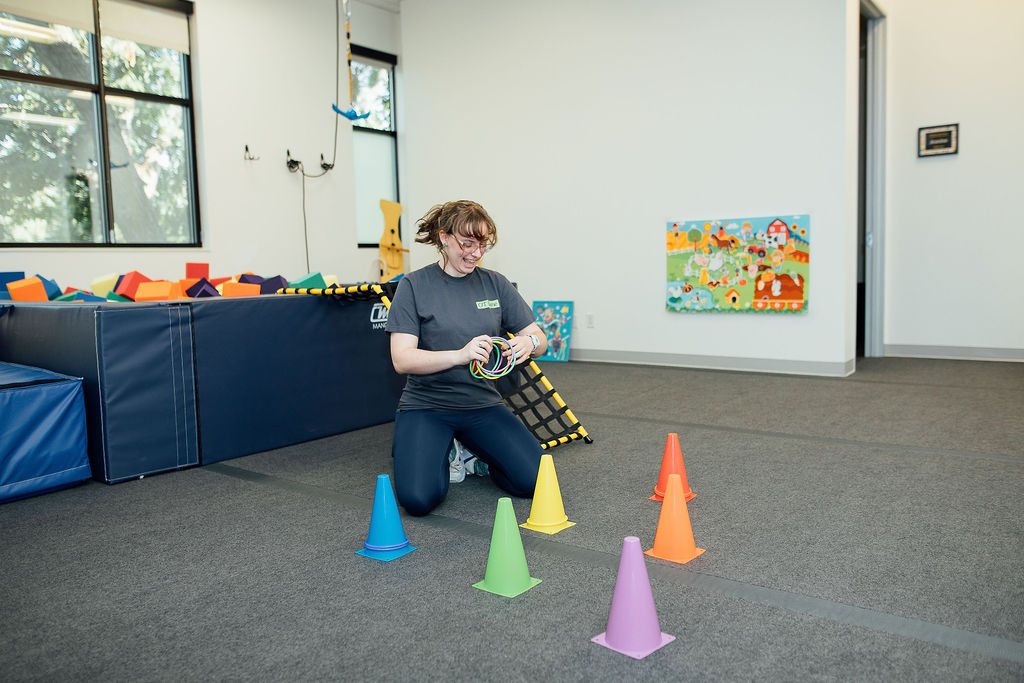
The session opens on the swings or the suspended obstacle course, with heavy work like climbing and pushing to help the body settle. Next comes a planning game: the child maps a three-step obstacle route, says it out loud, then runs it. At the table in the fine motor room, the child practices five words with a visual checklist. The session ends with a calm-down choice, a quick recap, and one home strategy for the parent.
Notice what the session trains. The obstacle route practices planning and order. The writing task practices handwriting with a visual support. The calm-down choice practices self-regulation. One session, three skill areas, all wrapped in play.
For a closer look at the gym side of this work, see our guide to ot sensory integration therapy.
Where medication helps and where OT helps
Medication and OT sit side by side in an ADHD plan. Your child's doctor or prescriber decides on and manages medication. OT focuses on skills and daily participation. That split is the core of how occupational therapy and ADHD care work together.
The 2019 American Academy of Pediatrics guideline sets the order by age (AAP):
- Ages 4 to 5: parent training in behavior management and/or behavioral classroom interventions come first. Medication may be considered later if those fall short.
- Ages 6 to 11: FDA-approved medication along with parent training and/or behavioral classroom supports, preferably both.
The CDC adds that treatments often work best when used together, and that school is a necessary part of any treatment plan. OT can help by building skills that make home routines and classroom work easier, and by sharing strategies with teachers.
Questions about dose, timing, or side effects belong with the prescriber. A good OT will ask what your child takes and when, simply to plan sessions around the times your child feels most ready.
What to share with your OT
The OT can do more with a full picture. Bring these to the first visit if you have them:
- The ADHD diagnosis and who made it
- Any IEP or 504 plan, plus recent teacher notes or report cards
- Current medications and the times your child takes them
- Two or three daily tasks that cause the most stress at home
- Handwriting samples or schoolwork that shows the struggle
One more point on roles. An OT evaluates skills and daily function. A pediatrician, psychologist, or psychiatrist diagnoses ADHD. If you suspect ADHD and have no diagnosis yet, your pediatrician is the place to start.
Sensory diet for ADHD: honest expectations
A sensory diet for ADHD is a planned set of movement and sensory activities spread through the day. Some kids find it helpful for settling or waking up. The evidence for specific tools is still thin, so expectations should stay modest.
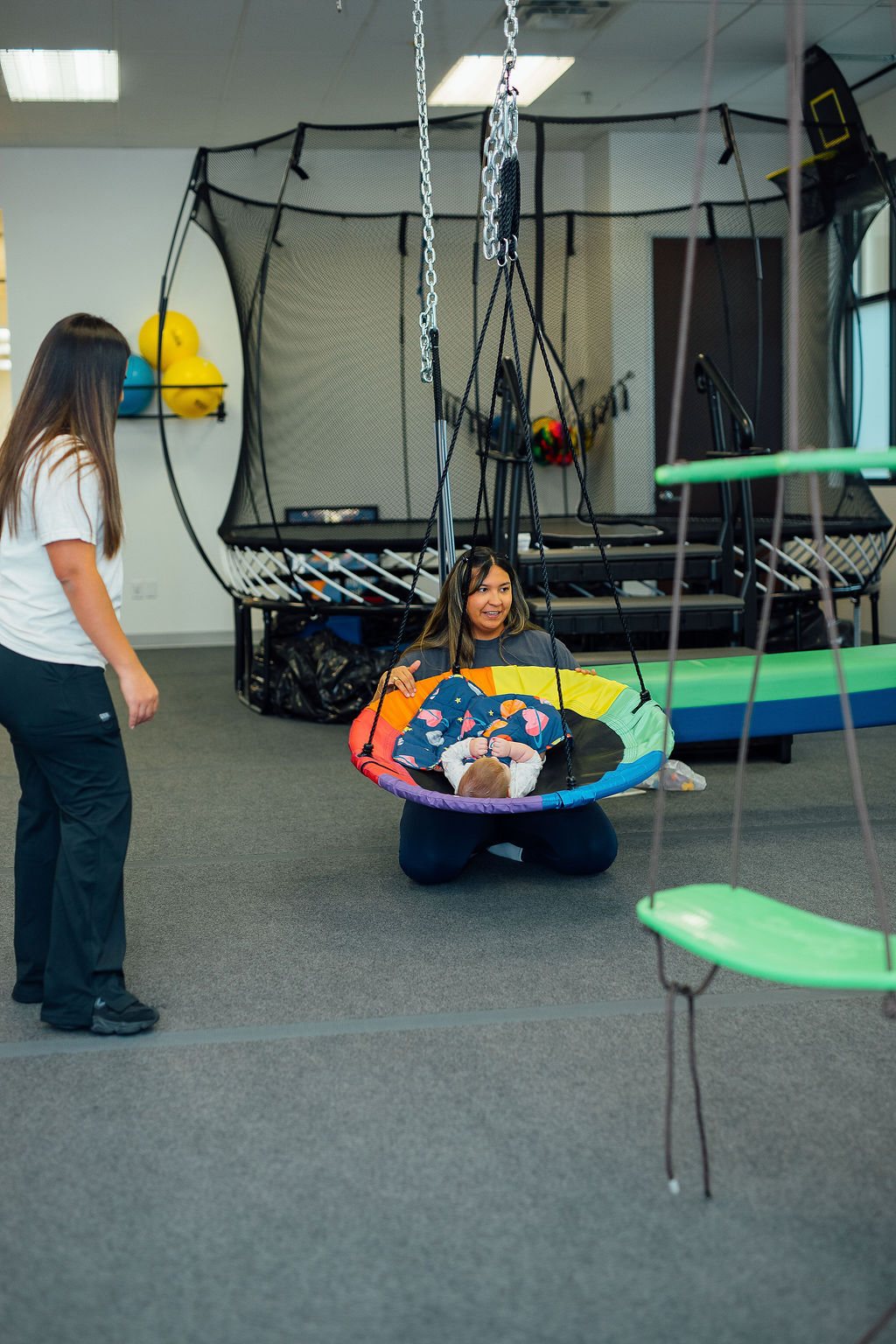
The same 2020 review that backed handwriting practice rated sensory-based tools like weighted vests and stability balls as low-strength evidence for classroom participation (Grajo et al.). A sensory diet works best when an OT designs it around your child and checks whether it helps.
In real life, a sensory diet can be simple. A child might carry the laundry basket before homework, do ten wall push-ups before dinner, and take a short swing break after school. The OT picks activities, sets the timing, and watches what changes. If a tool shows no clear benefit after a fair trial, it can come off the list.
Our sensory integration ADHD primer covers the sensory side in more depth, and our sensory integration therapy page explains the service.
When a speech therapist for ADHD helps too
A speech therapist for ADHD can help when language, conversation, or planning skills are part of the struggle. That overlap is common.
A 2017 review of 21 studies with more than 2,000 children found that kids with ADHD scored lower on expressive, receptive, and pragmatic language than peers without ADHD (Murdoch Children's Research Institute). Pragmatic language means the social side of talking, like staying on topic and taking turns.
According to ASHA, a speech-language pathologist can work on language and social skills, help a child plan and organize tasks, and team up with teachers on tools like checklists and planners. Many families pair OT with pediatric speech therapy for that reason.
The two roles overlap in useful ways. An OT might help a child follow a three-step routine with a picture list. An SLP might help the same child retell what happened at recess in the right order. Both are planning skills, practiced from two angles. If listening seems to be part of the struggle, our guide to APD and ADHD explains how to tell the two apart.
Signs your child may benefit from OT
Your child may benefit from an OT evaluation when ADHD shows up in daily tasks, beyond focus alone. These signs are a good reason to ask about occupational therapy and ADHD support:
- Messy or slow handwriting, or a tight, tiring pencil grip
- Trouble getting dressed, with buttons, zippers, or shoe tying
- Meltdowns at transitions, like leaving the park or starting homework
- Clumsiness, frequent falls, or avoiding sports and playground games
- Morning and bedtime routines that fall apart without constant reminders
- Big reactions to noise, clothing tags, or crowded rooms

ADHD rarely travels alone. Nearly 78% (77.9%) of US children with current ADHD have at least one co-occurring condition, per the 2022 national survey (CDC). So a child with ADHD may also have motor, sensory, or language needs that an evaluation can sort out.
Oaklin Lane offers OT, speech, PT, sensory integration, and feeding therapy under one roof at our Rockwall and Lake Highlands clinics. That setup lets one team look at the whole child.
Frequently Asked Questions
Does occupational therapy and ADHD treatment work together?
Yes. Occupational therapy and ADHD treatment from a prescriber do different jobs and can sit in the same plan. The prescriber manages medication, and OT builds daily skills like routines, handwriting, and self-regulation.
Can occupational therapy help with ADHD without medication?
Occupational therapy can help children with ADHD build daily skills, with or without medication. The decision about medication belongs to your child's prescriber. The AAP lists parent training in behavior management as the first step for ages 4 to 5.
Does occupational therapy help ADHD in preschoolers?
OT can help preschoolers with ADHD build motor, self-care, and self-regulation skills through play. For ages 4 to 5, the AAP puts parent training in behavior management and classroom behavioral supports first, and OT can support those goals at home and in class.
How long does ADHD OT take?
It varies by child. Your OT sets goals after the evaluation, tracks progress at each session, and reviews the plan with you on a set schedule. Some goals take weeks and others take months.
Next step
Three things to keep from this guide. Medication treats symptoms, and OT builds daily skills. The strongest OT evidence for ADHD sits in executive function, handwriting practice, and peer-based social skills. Sensory tools can help some kids, and they work best when an OT designs and checks them.
If routines, handwriting, or transitions feel hard at home, start with our Get Started intake. The introductory form takes about 10 minutes and starts insurance verification. From there, our team connects with you about what you are noticing and what comes next.
Every child is different. Occupational therapy can help many kids with ADHD, and results depend on the child, their goals, and practice at home. Good neighbors show up, and we are here when you are ready.
Sources
- Danielson ML, Claussen AH, Bitsko RH, et al. "ADHD Prevalence Among U.S. Children and Adolescents in 2022: Diagnosis, Severity, Co-Occurring Disorders, and Treatment." Journal of Clinical Child & Adolescent Psychology, 2024;53(3):343-360 (CDC Stacks)
- CDC, "Clinical Care for ADHD" (treatment recommendations by age)
- American Academy of Pediatrics, 2019 ADHD Clinical Practice Guideline key action statements (Wolraich ML, et al. Pediatrics, 2019;144(4)), via AAP EQIPP
- American Occupational Therapy Association, children and youth practice resource on OT strategies for students with ADHD (PDF)
- Rodrigues EG, Sposito AMP. "Occupational therapists' interventions with children with attention-deficit/hyperactivity disorder: a scoping review." Cadernos Brasileiros de Terapia Ocupacional, 2026;34:e4148
- Lino F, Chieffo DPR. "Developmental Coordination Disorder and Most Prevalent Comorbidities: A Narrative Review." Children (Basel), 2022
- Grajo LC, Candler C, Sarafian A. "Interventions Within the Scope of Occupational Therapy to Improve Children's Academic Participation: A Systematic Review." American Journal of Occupational Therapy, 2020;74(2)
- Fox A, Dishman S, Valicek M, Ratcliff K, Hilton C. "Effectiveness of Social Skills Interventions Incorporating Peer Interactions for Children With Attention Deficit Hyperactivity Disorder: A Systematic Review." American Journal of Occupational Therapy, 2020;74(2):7402180070
- Murdoch Children's Research Institute, "Kids with ADHD more likely to have language problems" (Korrel H, Sciberras E, et al., Journal of Child Psychology and Psychiatry, 2017), February 13, 2017
- American Speech-Language-Hearing Association, "Attention-Deficit/Hyperactivity Disorder (ADHD)"