
Auditory processing disorder: how it is tested and what therapy helps

An audiologist diagnoses auditory processing disorder (APD). After that, auditory training for APD works best as one part of a plan that also includes classroom changes and language support from a speech-language pathologist (SLP).
This guide is for parents whose child hears fine on a hearing test but still misses directions, asks "what?" all day, or falls apart in a noisy classroom. You will learn who tests for APD, what the tests involve, what the research says about training, and where speech therapy helps.
A licensed clinician on our team reviewed this guide before it went live. Our clinical team has served more than 10,000 kids over 22 years, and our speech-language pathologists work with children on listening and language every week.
How is auditory processing disorder tested and treated?
| Testing starts with a full hearing test to rule out hearing loss. If hearing is normal, an audiologist gives a central auditory test battery, a set of listening tests that each measure a different skill. Treatment then targets the specific weak skills found, often with auditory training, classroom supports, and language therapy together. |
|---|
One fact shapes everything that follows. The American Speech-Language-Hearing Association (ASHA) says there is currently no reference standard for diagnosing central auditory processing disorder. Different clinics use different tests and different cutoffs, so two good audiologists can reach different answers for the same child.
That is why the details of the APD test matter so much, and why a careful plan names the exact skill it is trying to build.
How to diagnose APD: who does what
If you are asking how to diagnose APD, the answer starts with one professional. Only an audiologist can diagnose APD. The American Academy of Audiology's 2010 guidelines state it plainly: the diagnosis must come from an audiologist. Other professionals add to the picture of how the child functions day to day.
- Audiologist: tests hearing and central auditory skills, then makes or rules out the APD diagnosis.
- Speech-language pathologist: evaluates language, including how a child understands and uses spoken language. ASHA assigns SLPs the job of diagnosing problems in the language side of listening.
- Psychologist: checks attention, memory, and learning, which can look like listening problems.
- Teacher: reports what happens in a real classroom, where most APD struggles show up.
The APD medical history
The APD medical history is a big part of the workup. ASHA lists the case history items audiologists ask about, including ear infections and ear surgeries, prenatal and birth history such as prematurity or low birth weight, neurologic history such as head injury, medications, family history, and school performance. Repeated ear infections in the toddler years are one of the possible causes ASHA names.
Oaklin Lane leaves APD diagnosis to audiologists. When our speech team sees signs of an auditory processing problem, we refer the family to audiology and keep working on language skills in the meantime.
APD test and assessment: what happens
An APD assessment has two stages. First the audiologist confirms the ears work. Then the audiologist tests how the brain handles what the ears pick up.
Step 1: rule out hearing loss
The 2010 guidelines call for a peripheral hearing check before any central testing, so the audiologist can confidently rule out ear problems. The suggested battery includes:
- Pure-tone audiometry: beeps at different pitches to find the softest sounds your child hears.
- Tympanometry: a quick puff of air pressure that checks the eardrum and middle ear.
- Otoacoustic emissions: a small probe that records sounds the inner ear makes when it works well.
- Word recognition: repeating recorded words in a quiet room.
Even a mild hearing loss can explain listening trouble, so this step comes first every time.
Step 2: the central auditory test battery
Next comes a battery of listening tasks. ASHA groups them into categories, and most batteries draw from these:
- Dichotic listening: different words play in each ear at the same time, and the child repeats both.
- Temporal patterns: the child hears tone sequences, like high-low-high, and names the pattern.
- Degraded speech: words are filtered or sped up, and the child repeats them.
- Speech-in-noise: the child repeats words over background noise.
ASHA describes a common diagnostic rule: scores at least 2 standard deviations below the mean on 2 or more tests. One extremely low score, at least 3 standard deviations below the mean, can also count when daily struggles back it up. In plain terms, a child has to score well below most kids their age, on more than one test.
When you get the report, look for three things: which tests were given, which ones your child scored low on, and what skill each low score points to. That last part tells you what type of help to ask for next.
How to test for APD by age
Age matters a lot. The 2010 guidelines say behavioral testing for APD in children 8 and under should be done with extreme caution, because young brains are still developing these skills.
If you are wondering how to test for APD in a younger child, start with a full hearing test and a talk with your pediatrician. Screening tools can start earlier. The SCAN-3:C is built for children ages 5 to 12. The Buffalo Model Questionnaire-Revised is a parent questionnaire with data for children under 6 as well as school-age kids.
Screening tools flag risk only. The questionnaire's own manual says its findings are separate from a diagnosis, and the 2010 guidelines warn that checklists tend to over-refer. A high screening score is a reason to book an audiology evaluation, and a starting point for that visit.
For a younger child with listening worries, the 2010 guidelines suggest families and educators can begin enriched listening activities and auditory games while the child grows into formal testing.
How common APD is
Reported rates of APD in school-age children range from 0.2% to 6.2%. That is a huge spread, and the reason is the criteria.
In one study ASHA cites, between 7.3% and 96% of the same group of referred children qualified for an APD diagnosis, depending on which tests and cutoffs were used. Same children, wildly different answers. When you get results, ask which tests were given and which criteria the audiologist used.
Auditory training for APD: what the research shows
The evidence for auditory training for APD is still thin. Training matched to a child's specific weak skill has the best early results. Broad, one-size programs show less.
What the big review found
In 2011, an ASHA systematic review of 25 studies looked at auditory and language programs for children with APD and language disorders. Some programs improved auditory skills, but there was little evidence the gains came from the auditory parts of the programs. Effects on spoken and written language were limited. The authors said some "cautious skepticism" is warranted until more evidence comes in.
The same review found that auditory integration training, a program built around listening to altered music, showed no effects in school-age children with APD.
Why matching the training to the deficit matters
Deficit-specific training looks more promising. In a small randomized blinded study, 10 children with a spatial processing deficit, trouble picking out speech from noise coming from other directions, trained about 15 minutes a day for 12 weeks. The group using LiSN & Learn, a program built for that exact deficit, improved on spatial listening tests. The group using Earobics, a broader program, showed no significant change.
Two cautions. Ten children is a tiny sample, and the authors distribute the LiSN & Learn software. Still, the pattern matches the bigger picture: auditory training for APD should target the skill the APD assessment found weak.
Questions to ask before you start a program
- Which skill from my child's test results does this program target?
- How will we measure change, and with which test?
- How many minutes a day, for how many weeks?
- When will my child be re-tested?
If a program promises to fix every listening problem at once, treat that as a warning sign. The research supports narrower goals.
Classroom supports and remote microphones
Classroom changes help many children with APD listen better right away. Remote microphones have the strongest research among these supports. Classroom supports also work alongside auditory training for APD, and many children use both at once.

A remote microphone system has the teacher wear a small microphone that sends their voice straight to the child's ears. In a 2020 randomized controlled trial, 26 children with APD, ages 7 to 12, were split into two groups. The 13 who used remote microphones in class for 6 months reported clearly better classroom listening. Their unaided listening and attention skills stayed about the same, so the device helped while worn.
A 2020 review of remote microphone research reported average speech-in-noise gains of 6 to 10 dB. That is like moving the teacher's voice much closer to your child's desk.
The room itself matters too. ASHA lists acoustic fixes like covering hard, echoing surfaces, adding sound-absorbing materials, using dividers, and cutting down on competing noise. A carpeted reading corner can be far easier to listen in than a tiled cafeteria.
Other supports schools often use:
- Preferential seating near the teacher and away from doors, fans, and hallway noise.
- Written instructions to back up spoken directions.
- Slower speech and visuals paired with verbal teaching, which ASHA lists as classroom strategies.
- An IEP or 504 plan that puts these supports in writing.
Where speech therapy helps
An SLP treats the language skills that sit on top of listening. That includes understanding directions, phonological awareness (hearing and playing with the sounds in words), vocabulary, and listening strategies a child can use in class.
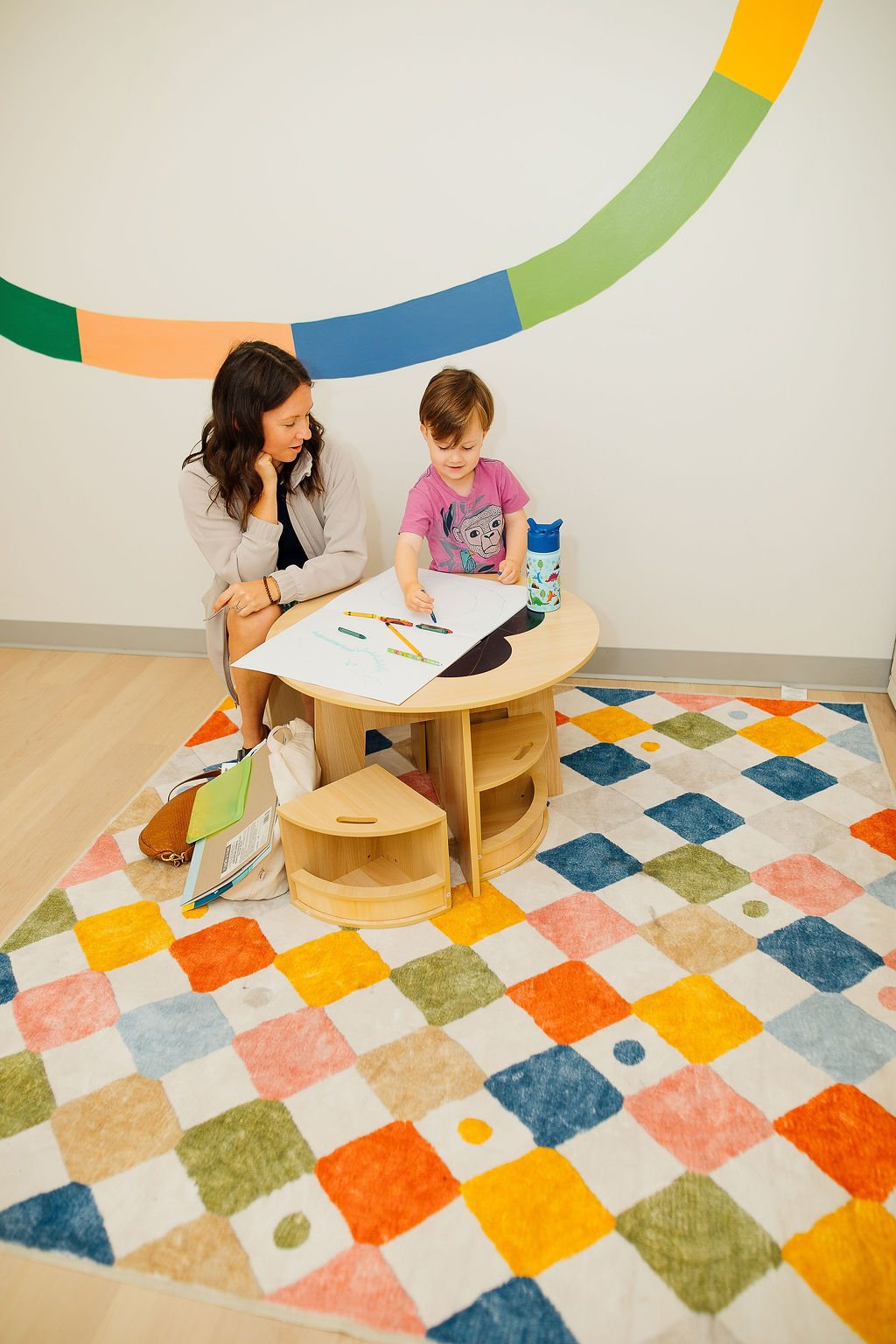
In a session, that might look like rhyming and sound-blending games, practice following two-step directions, building the words a child needs for science or math, or role-playing how to ask a teacher to repeat something. The goal is a child who understands more and knows what to do when they miss something.
Some researchers go further. Alan Kamhi, writing in an ASHA journal in 2011, argued that clinicians should treat children diagnosed with APD the same way they treat children with language and learning disabilities. His view is that auditory problems often travel with language and reading struggles, so language-focused therapy addresses what matters most for school.
In practice, many families combine both: auditory training for APD where the audiologist finds a specific deficit, plus speech therapy for language and literacy. Learn how our team approaches pediatric speech therapy for listening and language.
Signs that prompt an audiology referral at Oaklin Lane
During a speech evaluation, our SLPs watch for patterns that point past language alone: a child who does well one-on-one in a quiet room but struggles with any background noise, frequent requests to repeat, or a history of repeated ear infections. When those show up, the SLP recommends an audiology evaluation and explains the results at the caregiver conference.
Speech therapy sessions at our clinics usually run 30 minutes, and most children come twice a week. Every family also gets a home program, so listening and language practice continues between visits.
ADHD hearing issues and APD overlap
Many parents first notice ADHD hearing issues: a child who seems to tune out or forget what was said. ASHA notes that children with attention, cognition, or language diagnoses are more likely to have a coexisting APD diagnosis, and the symptoms overlap, so careful testing has to tell them apart. That matters for treatment too. Auditory training for APD targets listening skills, so it helps most when testing shows a true auditory deficit.
We cover the full comparison in our guide to APD and ADHD, and how OT supports attention in our guide to occupational therapy and ADHD.
Frequently Asked Questions
How long does auditory training for APD take?
It depends on the program and the deficit. In one study of deficit-specific training, children trained about 15 minutes a day for 12 weeks. Your audiologist should set goals and a re-test date before training starts.
What age can a child get an APD test?
Screening tools like the SCAN-3:C start at age 5. Full diagnostic testing is most reliable after age 8, since the 2010 audiology guidelines urge extreme caution for children 8 and under.
Can a speech therapist diagnose APD?
An SLP can diagnose language problems and flag listening concerns, but the APD diagnosis itself comes from an audiologist. SLPs then treat the language and listening skills that affect school.
Does APD go away?
Some listening skills keep maturing through childhood, which is one reason testing young children calls for caution. Many children also do better with classroom supports, training matched to their deficit, and language therapy. Ask your audiologist about re-testing as your child grows.
Next step
Two things to take with you. An audiologist makes the APD diagnosis, and the test results should name the exact skills that are weak. Then the best plans match auditory training for APD to those skills and add classroom supports and language therapy.
Want to go deeper? Our pediatric speech therapy page explains how our SLPs work on language and listening. Our guides on APD and ADHD and on occupational therapy and ADHD cover the overlaps.
When you are ready, fill out our 10-minute Get Started form. Oaklin Lane's team will talk with you about what you are noticing, check your benefits, and schedule a speech evaluation, usually within 2 weeks.
Every child is different. Therapy can help, and results vary from child to child. This guide is general information and carries no guarantee of a specific outcome. Talk with your child's doctor and an audiologist about your child's needs.
Sources
- ASHA Practice Portal, Central Auditory Processing Disorder
- American Academy of Audiology (2010), Clinical Practice Guidelines: Diagnosis, Treatment and Management of Children and Adults With CAPD
- ASHA Evidence Maps summary of the AAA 2010 guidelines
- Pearson, SCAN-3:C Test for Auditory Processing Disorders in Children (ages 5 to 12)
- Buffalo Model Questionnaire-Revised manual (September 2020 update)
- Fey et al. (2011), Auditory Processing Disorder and Auditory/Language Interventions: An Evidence-Based Systematic Review, LSHSS 42(3)
- ASHA Evidence Maps summary of Fey et al. (2011)
- Cameron, Glyde, and Dillon (2012), Efficacy of the LiSN & Learn auditory training software, Audiology Research
- Stavrinos et al. (2020), Remote microphone hearing aid use in children with APD: a randomised controlled trial, Frontiers in Neuroscience
- Schafer, Kirby, and Miller (2020), Remote Microphone Technology for Children with Hearing Loss or Auditory Processing Issues, Seminars in Hearing
- Kamhi (2011), What Speech-Language Pathologists Need to Know About Auditory Processing Disorder, LSHSS (ERIC record)